 Bug FAQ
Cross Orbweaver
Araneus diadematus · Order: Araneae · Family: Araneidae
Also called: European Garden Spider, Garden Cross Spider, Garden Orb-Web Spider, Garden Spider
Source: Wikipedia, Penn State Extension
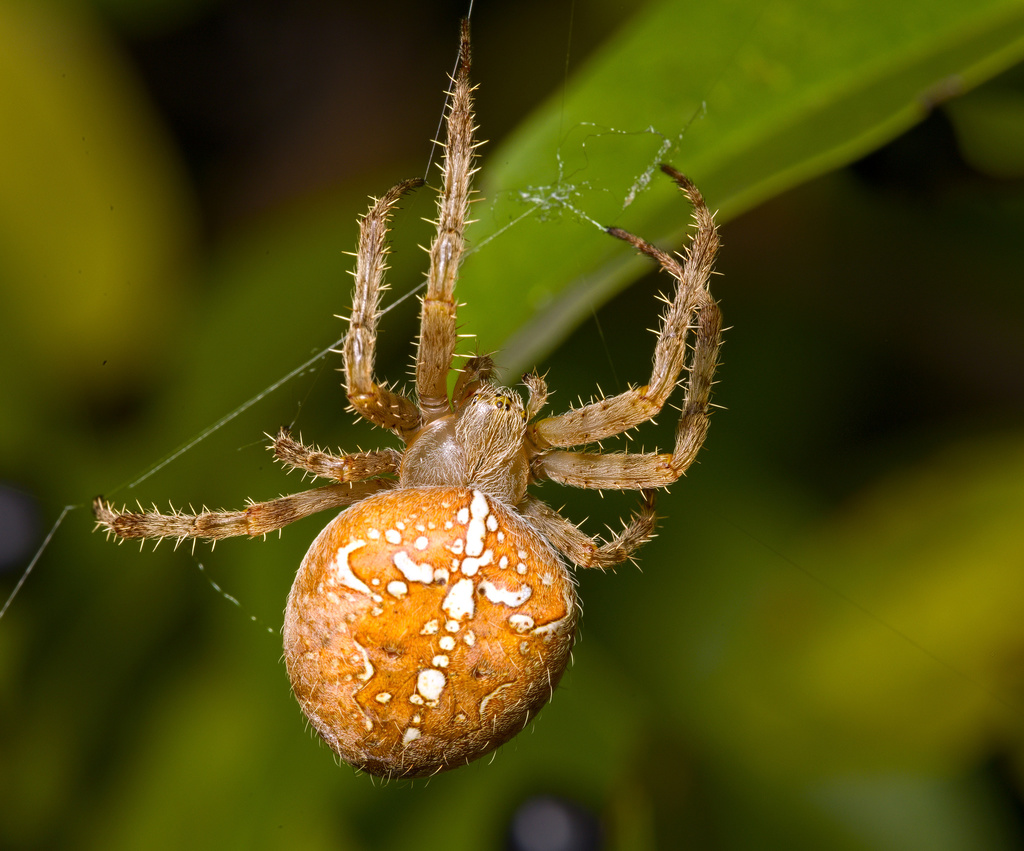
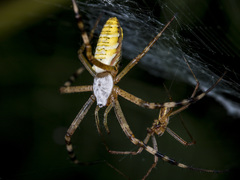
Adult cross orbweavers have a yellow-to-brown abdomen with a distinctive white cross pattern formed by four or more segments. They are common around buildings with exterior lights and are most often seen from late summer through autumn.
Source: Penn State Extension, Wikipedia
How to recognize it
The background color ranges from light yellow to dark grey, with two wavy longitudinal lines and several white or yellow spots.
Source: Penn State Extension
Size
Females are 6.5 to 20 mm long, while males are 5.5 to 13 mm.
Source: Wikipedia
Is it a pest in the house?
They are often found on or near illuminated parts of buildings, especially in rural areas.
Source: Penn State Extension
Does it bite or sting?
They bite humans only when cornered or otherwise provoked. Bites can cause pain, swelling, redness, and sometimes anxiety, nausea, headache, or muscle cramps. When disturbed they may vibrate rapidly in their web to blur their shape.
Source: Wikipedia, Penn State Extension
Where it lives
It is an orb-weaver spider native to Europe and introduced to North America.
Source: Wikipedia
What it eats
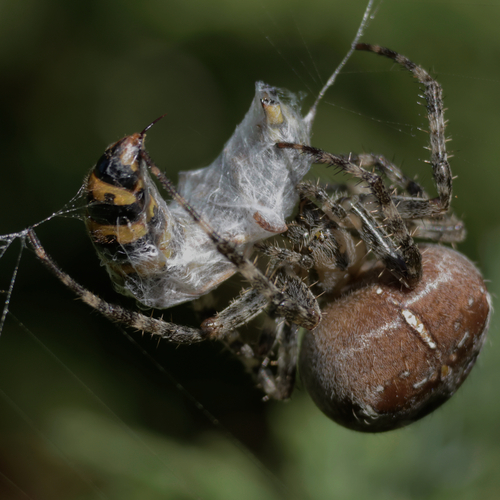
It captures prey in its web, wraps it in silk, and may store the prey for later consumption. Adults may cannibalize each other around the time of mating.
Source: Wikipedia
Life cycle
Females lay 300 to 900 eggs in protected sites after leaving their webs in late September. Sometimes the female eats the male after mating.
Source: Penn State Extension, Wikipedia
When you see it
Adults are present from late summer through autumn.
Source: Penn State Extension
Where it comes from
It is native to Europe and has been introduced to North America.
Source: Wikipedia
Lookalikes
They are sometimes called pumpkin spiders, a name also used for Araneus marmoreus. The carapace shows three dark longitudinal lines, similar to the banded garden spider. Four elongated spots near the front of the abdomen create the cross appearance.
Source: Wikipedia, Penn State Extension
Where it is found in the US
Recorded in 38 of 51 states and DC. Most records: Washington, California, Oregon, Michigan, Massachusetts, New York, Maine, Wisconsin.
Darker = more records. Counts are museum and citizen-science records, not population size.
Source: GBIF
Status: introduced in North America; introduced in Canada; introduced in United States. Source: iNaturalist
Months it is reported in the US
Source: GBIF
More photos

Questions people ask
Do they bite people?
Yes, they bite only when cornered, causing mild pain, swelling and redness.
Source: Wikipedia, Penn State Extension
Where are cross orbweavers found?
They are native to Europe and have been introduced to North America.
Source: Wikipedia
How can I identify a cross orbweaver?
Look for a yellow-to-brown abdomen with a white cross formed by four or more segments and two wavy longitudinal lines.
Source: Penn State Extension, Wikipedia
When are they most common?
Adults are most common from late summer through autumn.
Source: Penn State Extension
Same family (Araneidae)

Sources
- Wikipedia: https://en.wikipedia.org/wiki/Araneus_diadematus
- Penn State Extension: https://extension.psu.edu/cross-orbweaver-spider
Look it up elsewhere: GBIF · iNaturalist · BugGuide · ITIS · Wikipedia
Text written 2026-10-23 from the sources above and checked sentence by sentence against them. Data fetched 2026-10-23.