 Bug FAQ
Spotted Orbweaver
Neoscona crucifera · Order: Araneae · Family: Araneidae
Also called: Hentz's Orbweaver, Barn Spider
Source: Wikipedia, UF/IFAS, extension.msstate.edu

Spotted orbweavers are medium-sized spiders that build large round webs near lights in late summer and fall. They bite only when provoked; the bite is harmless to people and pets.
Source: Wikipedia, UF/IFAS, extension.msstate.edu
How to recognize it
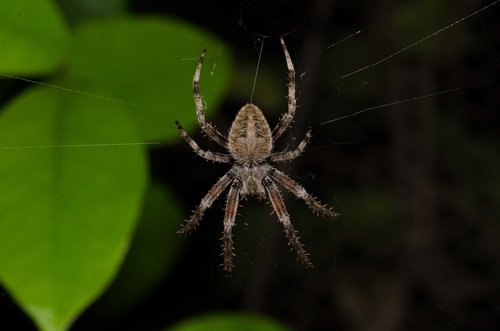
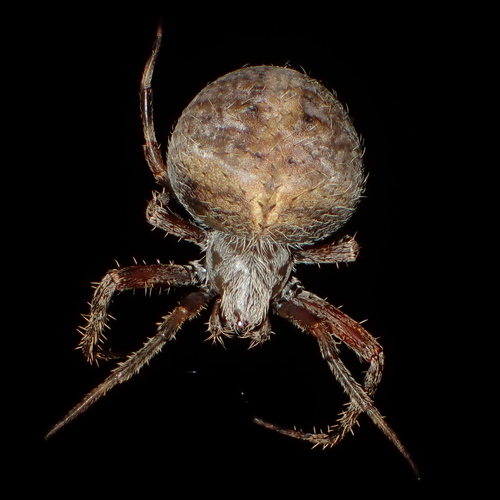
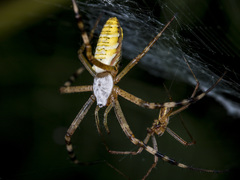
The abdomen’s top is brown and hairy, while the underside is black with two white spots. Legs show alternating light and dark brown bands. Females are reddish-brown to brown; males are lighter brown with nearly black sides on the carapace. The two white spots on the belly give the spider its common name, spotted orbweaver.
Source: Wikipedia, UF/IFAS, extension.msstate.edu
Size
Adult females measure about 9.5 to 19 mm (0.37 to 0.75 in) long; males are a bit smaller.
Source: Wikipedia
Is it a pest in the house?
Webs are often found on porches, decks and near entryways where exterior lights attract insects. People usually notice them only when walking near a lit area at night or when they walk into a web.
Source: extension.msstate.edu, UF/IFAS
Does it bite or sting?
They will bite if provoked, but the venom is not dangerous and bites cause no serious effects.
Source: Wikipedia, UF/IFAS, extension.msstate.edu
How to get rid of it
Control is usually unnecessary because they are beneficial predators of insects. If a web is too close to where people walk, a broom can be used to move the spider.
Source: UF/IFAS, extension.msstate.edu
Where it lives
They spin large orb webs on buildings and other structures, often a few feet above ground near outdoor lights.
Source: Wikipedia
What it eats
Their webs catch moths, crane flies, grasshoppers, bees, beetles and other insects.
Source: Wikipedia
Life cycle
Females lay up to 1,000 eggs in a fluffy yellow sac wrapped in a rolled leaf. They rebuild a new web each night and eat the old one in the morning to recycle nutrients.
Source: Wikipedia
When you see it
They are most noticeable in late summer and early fall and may become active during the day in the fall.
Source: Wikipedia
Where it comes from
They occur across the United States from Maine to Florida, west to Minnesota, Arizona and coastal southern California, and also in Mexico.
Source: Wikipedia
Lookalikes
The name “barn spider” can also refer to a different species, Araneus cavaticus, which looks similar. Neoscona hentzii was later merged with N. crucifera, so older references may use that name.
Where it is found in the US
Recorded in 46 of 51 states and DC. Most records: Texas, California, North Carolina, Ohio, Virginia, Illinois, Georgia, Maryland.
Darker = more records. Counts are museum and citizen-science records, not population size.
Source: GBIF
Status: native in North America; native in United States; native in Canada. Source: iNaturalist
Months it is reported in the US
Source: GBIF
More photos
Questions people ask
Do they bite people?
They may bite if handled, but the bite is mild and not medically serious.
Source: Wikipedia, UF/IFAS, extension.msstate.edu
Where do they build their webs?
They spin large orb webs on buildings, porches, decks and other structures near outdoor lights.
Source: Wikipedia, extension.msstate.edu
Are they harmful to gardens?
No, they help by catching many garden insects such as moths and beetles.
When are they most common?
They are most noticeable in late summer and early fall, sometimes becoming active during the day in the fall.
Source: Wikipedia
Same family (Araneidae)

Sources
- Wikipedia: https://en.wikipedia.org/wiki/Neoscona_crucifera
- UF/IFAS: https://edis.ifas.ufl.edu/publication/IN569
- extension.msstate.edu: https://extension.msstate.edu/newsletters/bugs-eye-view/2016/hentz-orbweaver-vol-2-no-33
Look it up elsewhere: GBIF · iNaturalist · BugGuide · ITIS · Wikipedia
Text written 2026-10-23 from the sources above and checked sentence by sentence against them. Data fetched 2026-10-23.