 Bug FAQ
Violet Checkered Beetle
Necrobia violacea · Order: Coleoptera · Family: Cleridae
Also called: Black-legged Ham Beetle, Cosmopolitan Blue Bone Beetle, Iridescent Blue Bone Beetle
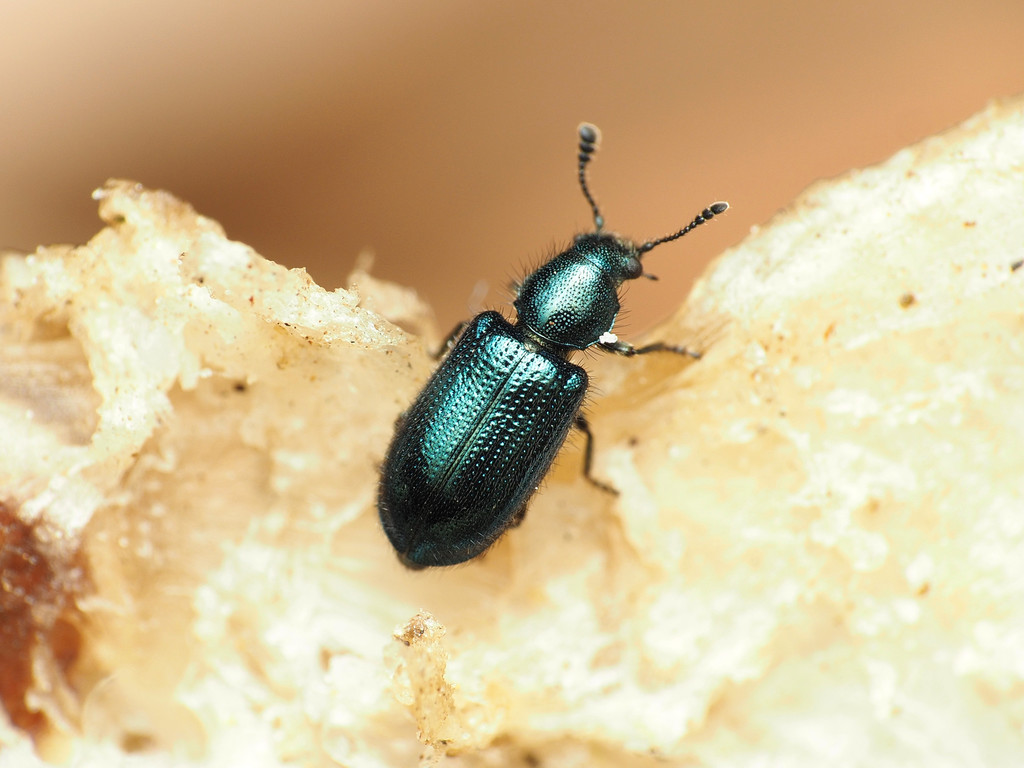
The violet checkered beetle is a tiny, metallic blue-green beetle about 4 to 5 mm long and roughly two-and-a-half times longer than wide. It lives wherever decaying animal matter is present, such as stored dried meat, bones, fish, cheese, and even carrion, and it is found throughout the Palearctic region. Adults feed on oily foods like aged cheese and cured meats, while larvae develop in about 25 to 35 days, pupating in a cocoon inside the food source.
Source: Wikipedia
How to recognize it
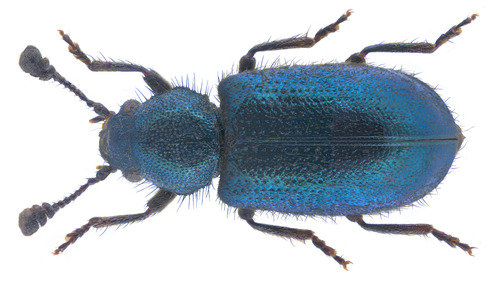
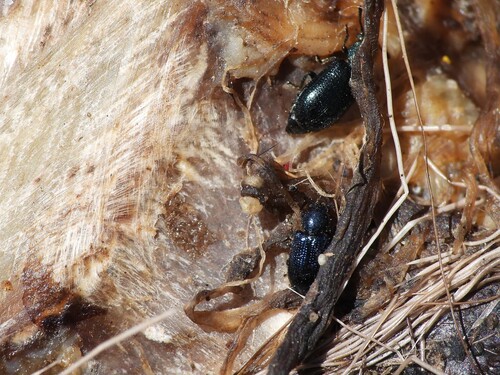
Its antennae are completely black and end in a wide, flattened three-lobed club. The beetle’s body and legs shine with an iridescent metallic blue-green to green color.
Source: Wikipedia
Size
Adults measure only four to five millimetres in length.
Source: Wikipedia
Is it a pest in the house?
It belongs to the subfamily Korynetinae and is uniformly metallic shiny green or blue. The beetle is often encountered in forensic examinations of older bodies exposed to the elements.
Source: Wikipedia
What it eats
Larvae also consume the pupae of Sarcophaga flies.
Source: Wikipedia
Life cycle
Larval development takes about 25 to 35 days. When ready to pupate, they spin a cocoon either within the infested material or in a tunnel they bore elsewhere.
Source: Wikipedia
When you see it
Adults are long-lived and will fly in search of food under warm conditions.
Source: Wikipedia
Where it comes from
The species is native to the Palearctic region.
Source: Wikipedia
Lookalikes
Unlike Korynetes violaceus, its jaw palpi end in a spindle-shaped, truncated tip rather than an axe shape. Its pronotum widens in a relatively straight line toward the rear, unlike the evenly curved pronotum of Korynetes species.
Source: Wikipedia
Where it is found in the US
Recorded in 31 of 51 states and DC. Most records: Wisconsin, Michigan, Alaska, Kansas, Colorado, New York, Pennsylvania, Missouri.
Darker = more records. Counts are museum and citizen-science records, not population size.
Source: GBIF
Months it is reported in the US
Source: GBIF
More photos
Questions people ask
What does the violet checkered beetle look like?
It is a tiny metallic blue-green beetle about 4 to 5 mm long with black antennae ending in a three-lobed club.
Source: Wikipedia
Where can I find these beetles?
They live wherever decaying animal matter is present, such as stored dried meat, bones, fish, cheese, and carrion.
Source: Wikipedia
What do they eat?
Adults feed on oily foods like aged cheese and cured meats, while larvae also eat the pupae of Sarcophaga flies.
Source: Wikipedia
How long does it take for them to develop?
Larval development takes about 25 to 35 days, after which they pupate in a cocoon made in the food source or a nearby tunnel.
Source: Wikipedia
Same family (Cleridae)



Sources
- Wikipedia: https://en.wikipedia.org/wiki/Necrobia_violacea
Look it up elsewhere: GBIF · iNaturalist · BugGuide · ITIS · Wikipedia
Text written 2026-10-26 from the sources above and checked sentence by sentence against them. Data fetched 2026-10-26.