 Bug FAQ
Bee-eating Beetle
Trichodes apiarius · Order: Coleoptera · Family: Cleridae
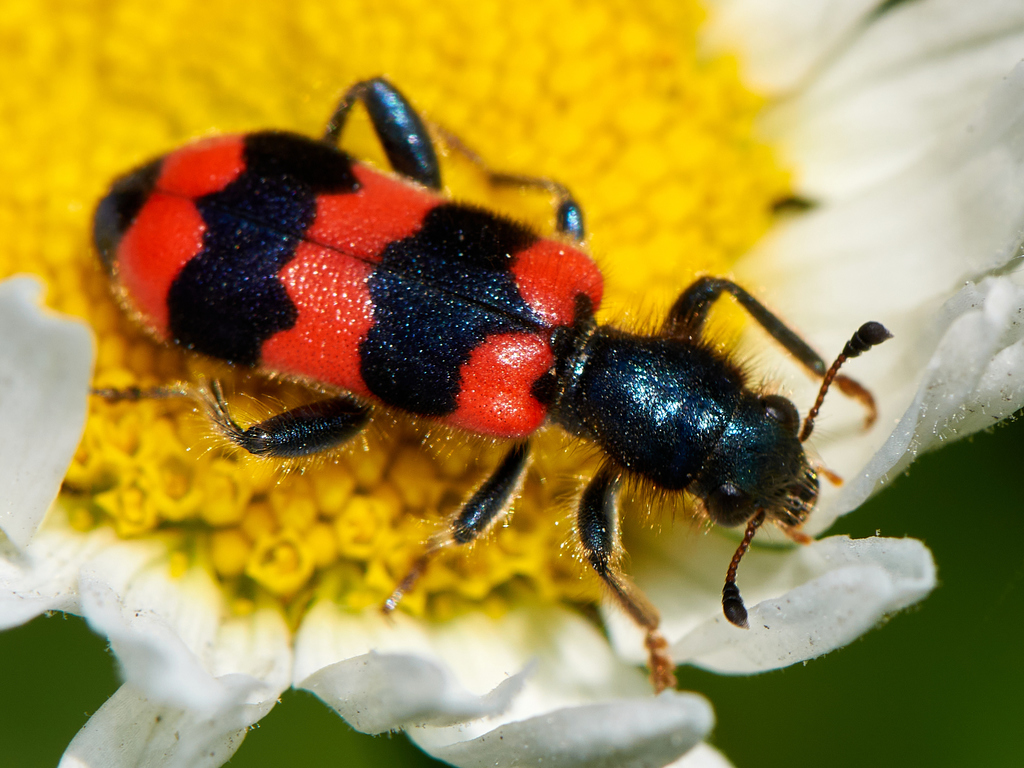
Adult beetles are 9 to 16 mm long, with a hairy body, blue or black head, and bright red elytra marked with black bands. They appear on Apiaceae flowers in May-June, lay eggs in solitary or honey-bee nests, and their larvae parasitise bee brood. Adults feed on pollen and also hunt small insects, eating larvae and nymphs.
Source: Wikipedia
How to recognize it
The beetle is small and hairy, with a shiny blue or black head and a bright red wing case that has black bands.
Source: Wikipedia
Size
Adults measure between 9 and 16 mm (about 0.35 to 0.63 in).
Source: Wikipedia
Where it lives
You can find them on flowers, especially Apiaceae, from May through June.
Source: Wikipedia
What it eats
Adults eat pollen and also hunt small insects, consuming their larvae and nymphs.
Source: Wikipedia
Life cycle
The larvae develop as parasites inside bee nests, feeding on bee brood. Adults deposit eggs in solitary bee nests or honey-bee hives.
Source: Wikipedia
When you see it
They are active from May to June.
Source: Wikipedia
Where it comes from
They occur across most of Europe, the eastern Palearctic region, and North Africa.
Source: Wikipedia
Lookalikes
It can be told apart from Trichodes alvearius because its black band reaches the tip of the elytra.
Source: Wikipedia
Where it is found in the US
Recorded in 1 of 51 states and DC. Most records: Washington.
Darker = more records. Counts are museum and citizen-science records, not population size.
Source: GBIF
Questions people ask
How can I tell this beetle apart from similar species?
Look for the black band that reaches the end of the bright red elytra; other species lack this feature.
Source: Wikipedia
Same family (Cleridae)

Sources
- Wikipedia: https://en.wikipedia.org/wiki/Trichodes_apiarius
Look it up elsewhere: GBIF · iNaturalist · BugGuide · Wikipedia
Text written 2026-10-22 from the sources above and checked sentence by sentence against them. Data fetched 2026-10-22.