 Bug FAQ
European Red-bellied Clerid
Thanasimus formicarius · Order: Coleoptera · Family: Cleridae
Also called: Ant beetle / European Red-bellied Clerid, Ant Beetle, Ant-loving checkered beetle
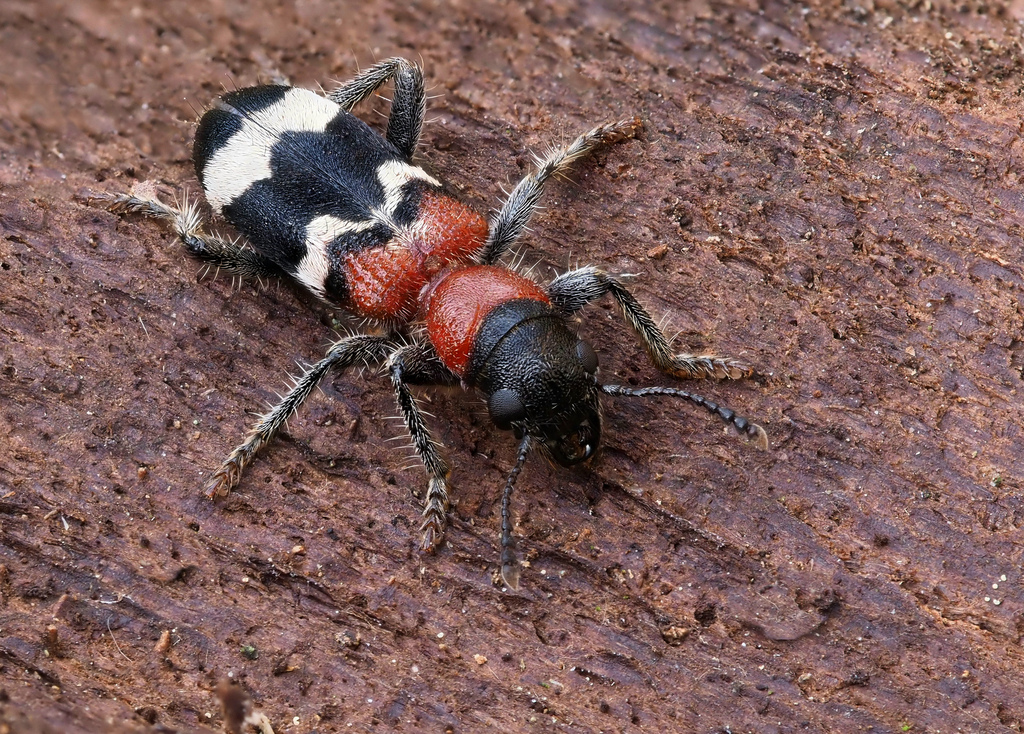
The European red-bellied clerid is a medium-sized, soft-bodied beetle with strong mandibles for tearing bark beetles. Adults overwinter at the bases of conifers, emerge in spring, and hunt bark beetles on lower parts of trees. Both larvae and adults prey on many bark-beetle species that attack coniferous and broad-leaved trees.
Source: Wikipedia
How to recognize it
Adults seize prey with all legs and bite between body segments to pull out soft parts of bark beetles.
Source: Wikipedia
Size
It is a medium-sized beetle with a relatively soft body and powerful jaws.
Source: Wikipedia
Where it lives
Adults spend winter at the base of conifer trees and rarely on deciduous trees. In spring they fly to the lower trunks of trees to hunt bark beetles.
Source: Wikipedia
What it eats
Adults feed on at least 27 bark-beetle species from 15 genera that infest both conifers and broad-leaf trees. Larvae live in bark-beetle galleries and eat the immature beetles.
Source: Wikipedia
Life cycle
Larvae develop slowly, remaining in the larval stage for about two years before pupating in the outer bark in autumn. Adult beetles live for four to ten months.
Source: Wikipedia
When you see it
Adults emerge in spring and are active through the warmer months. Females lay eggs from April to June.
Source: Wikipedia
Where it comes from
They are common predators of bark beetles throughout Europe.
Source: Wikipedia
Lookalikes
Its body shape and red coloration resemble velvet ants, which are known for painful stings.
Source: Wikipedia
Status: introduced in Canada. Source: iNaturalist
Questions people ask
What does the European red-bellied clerid eat?
It preys on many bark-beetle species that attack conifer and broad-leaf trees, both as an adult and as a larva.
Source: Wikipedia
When are these beetles active?
Adults emerge in spring, hunt on lower parts of trees, and females lay eggs from April to June.
Source: Wikipedia
Same family (Cleridae)


Sources
- Wikipedia: https://en.wikipedia.org/wiki/Thanasimus_formicarius
Look it up elsewhere: GBIF · iNaturalist · BugGuide · Wikipedia
Text written 2026-10-23 from the sources above and checked sentence by sentence against them. Data fetched 2026-10-22.