 Bug FAQ
Variable longhorn beetle
Stenocorus meridianus · Order: Coleoptera · Family: Cerambycidae


These beetles are about 15 to 27 mm long (0.6 to 1.1 in). They live across most of Europe, the Caucasus and Kazakhstan, but not in places like the Faroe Islands, Iceland, Ireland, Malta, or parts of Italy. Adults sometimes feed on the leaves of elm, maple and oak trees, and the larvae develop in damaged timber of sick trees.
Source: Wikipedia
How to recognize it
Legs are brown; the prothorax is black in females and brown in males.
Source: Wikipedia
Size
Body length ranges from 15 to 27 mm (about 0.6 to 1.1 in).
Source: Wikipedia
Where it lives
Found throughout Europe (except the Faroe Islands, Iceland, Ireland, Malta, and some Italian regions), the Caucasus and Kazakhstan.
Source: Wikipedia
Life cycle
The species takes 2 to 3 years to develop, with adults flying from May to July.
Source: Wikipedia
When you see it
Adults are active and can be seen flying between May and July.
Source: Wikipedia
Where it comes from
Native to Europe, the Caucasus and Kazakhstan.
Source: Wikipedia
More photos


Questions people ask
What do these beetles look like?
They are 15 to 27 mm long, have brown legs, and a prothorax that is black in females and brown in males.
Source: Wikipedia
Where can I find them?
They occur across most of Europe, the Caucasus and Kazakhstan, but not in the Faroe Islands, Iceland, Ireland, Malta, or some parts of Italy.
Source: Wikipedia
What do they eat?
Adults sometimes feed on leaves of elm, maple and oak trees, while larvae develop in damaged wood of sick trees.
Source: Wikipedia
When are they active?
Adults fly from May through July, and the whole life cycle lasts 2 to 3 years.
Source: Wikipedia
Same family (Cerambycidae)
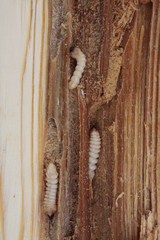 House LonghornHylotrupes bajulusCan damage your home
 Asian Longhorned BeetleAnoplophora glabripennisDamages trees, gardens or crops
 Red Milkweed BeetleTetraopes tetrophthalmus
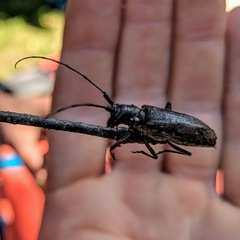 White-spotted SawyerMonochamus scutellatusCan damage your home
 Red Pine Longhorn BeetleStictoleptura rubra
 Spotted Longhorn BeetleRutpela maculataDamages trees, gardens or crops
Sources
- Wikipedia: https://en.wikipedia.org/wiki/Stenocorus_meridianus
Look it up elsewhere: GBIF · iNaturalist · BugGuide · Wikipedia
Text written 2026-10-23 from the sources above and checked sentence by sentence against them. Data fetched 2026-10-22.