 Bug FAQ
Red Milkweed Beetle
Tetraopes tetrophthalmus · Order: Coleoptera · Family: Cerambycidae

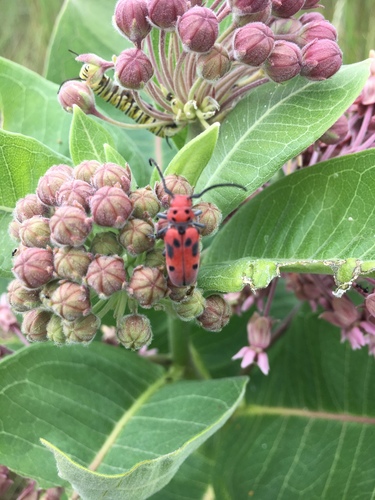
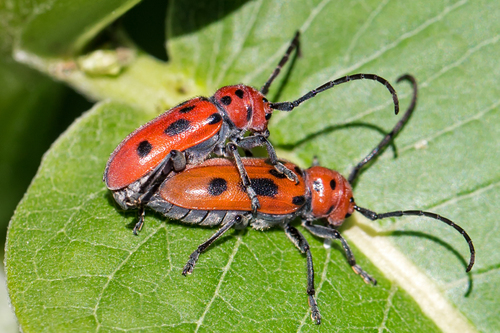
Red milkweed beetles are brightly colored red and black, warning predators that they are not edible. They live on common milkweed, feeding on its leaves, flowers, and roots, and lay eggs inside the plant stem in mid-summer.
Source: Wikipedia
How to recognize it
The beetle’s red and black colors serve as a warning that it is inedible.
Source: Wikipedia
Where it lives
They feed by opening veins in milkweed, which reduces exposure to the plant’s latex-like sap.
Source: Wikipedia
What it eats
Adults eat milkweed foliage and flowers; larvae eat the plant’s roots.
Source: Wikipedia
Life cycle
Females lay clutches of eggs inside the base of the milkweed stem in mid-summer.
Source: Wikipedia
When you see it
Egg-clutch laying occurs in mid-summer.
Source: Wikipedia
Where it is found in the US
Recorded in 38 of 51 states and DC. Most records: Illinois, Pennsylvania, New York, Ohio, Massachusetts, Maryland, Michigan, Wisconsin.
Darker = more records. Counts are museum and citizen-science records, not population size.
Source: GBIF
Status: native in North America; native in Canada; native in United States. Source: iNaturalist
Months it is reported in the US
Source: GBIF
More photos


Same family (Cerambycidae)
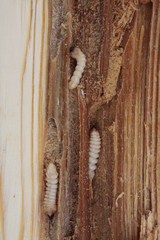 House LonghornHylotrupes bajulusCan damage your home
 Asian Longhorned BeetleAnoplophora glabripennisDamages trees, gardens or crops
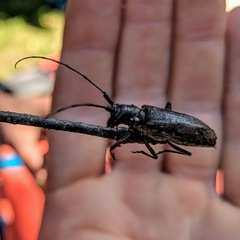 White-spotted SawyerMonochamus scutellatusCan damage your home
 Red Pine Longhorn BeetleStictoleptura rubra
 Spotted Longhorn BeetleRutpela maculataDamages trees, gardens or crops
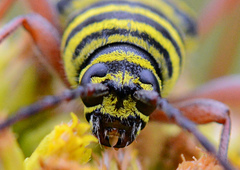 Locust BorerMegacyllene robiniae
Sources
- Wikipedia: https://en.wikipedia.org/wiki/Tetraopes_tetrophthalmus
Look it up elsewhere: GBIF · iNaturalist · BugGuide · ITIS · Wikipedia
Text written 2026-10-22 from the sources above and checked sentence by sentence against them. Data fetched 2026-10-22.