 Bug FAQ
Asian Longhorned Beetle
Anoplophora glabripennis · Order: Coleoptera · Family: Cerambycidae
Also called: Starry sky longhorned beetle, Asian Longhorn Beetle
Source: USDA APHIS

Adults are shiny black with white spots and have long black-and-white antennae that exceed their body length. Larvae are long, cylindrical, up to 5 cm long, and feed inside the trunks of maples, poplars, willows and elms, eventually killing the tree.
Source: USDA APHIS, Wikipedia
Size
Larvae can grow to about 5 cm (2 in) long and 0.5 cm (0.2 in) wide.
Source: Wikipedia
Is it a pest in the house?
The beetle can dramatically change forest and urban ecosystems by killing many hardwood trees. Trees cannot recover from the damage caused by the beetle.
Source: Wikipedia, USDA APHIS
How to get rid of it
Early detection is essential to stop the beetle from spreading. Pheromone and plant-kairomone traps can attract adult beetles. Infested trees cannot be saved and must be removed and destroyed by incineration or chipping.
Source: Wikipedia, USDA APHIS
Where it lives
In its native range the beetle infests maple, poplar, willow and elm trees.
Source: Wikipedia
What it eats
Both larvae and adults feed on the wood of hardwood trees such as maple, poplar, willow and elm.
Source: Wikipedia
Life cycle
Eggs hatch in 13 to 54 days, and larvae pass through at least five growth stages over one to two years.
Source: Wikipedia
When you see it
Adults first attack the crown and main branches, then move into the trunk as the crown dies.
Source: Wikipedia
Where it comes from
It originates from eastern Asia, especially eastern China and Korea.
Source: Wikipedia
Where it is found in the US
Recorded in 8 of 51 states and DC. Most records: Massachusetts, Ohio, Connecticut, South Carolina, Illinois, Pennsylvania, District of Columbia, New Jersey.
Darker = more records. Counts are museum and citizen-science records, not population size.
Source: GBIF
Status: introduced in United States. Source: iNaturalist
Months it is reported in the US
Source: GBIF
Questions people ask
How can I tell if I have an Asian longhorned beetle infestation?
Look for shiny black beetles with white spots and very long black-and-white antennae, and for signs of dead branches or holes in the bark of maples and other hardwoods.
Source: USDA APHIS, Wikipedia
What should I do if I find an infested tree?
Contact local authorities; the tree will need to be removed and the wood destroyed because it cannot be treated.
Source: USDA APHIS
Can traps help control the beetle?
Yes, traps using a pheromone and a plant kairomone can lure adult beetles and help monitor infestations.
Source: Wikipedia
Same family (Cerambycidae)
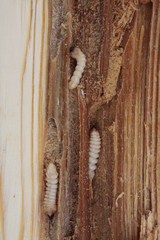 House LonghornHylotrupes bajulusCan damage your home
 Red Milkweed BeetleTetraopes tetrophthalmus
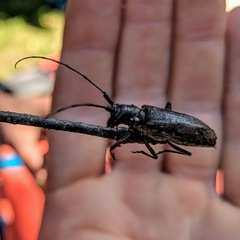 White-spotted SawyerMonochamus scutellatusCan damage your home
 Red Pine Longhorn BeetleStictoleptura rubra
 Spotted Longhorn BeetleRutpela maculataDamages trees, gardens or crops
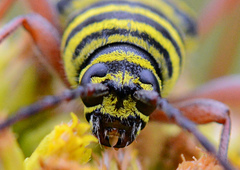 Locust BorerMegacyllene robiniae
Sources
- USDA APHIS: https://www.aphis.usda.gov/plant-pests-diseases/alb
- Wikipedia: https://en.wikipedia.org/wiki/Asian_long-horned_beetle
Look it up elsewhere: GBIF · iNaturalist · BugGuide · ITIS · Wikipedia
Text written 2026-10-22 from the sources above and checked sentence by sentence against them. Data fetched 2026-10-22.