 Bug FAQ
Two-spotted Lady Beetle
Adalia bipunctata · Order: Coleoptera · Family: Coccinellidae
Also called: Twospot Lady Beetle, Twospotted Lady Beetle

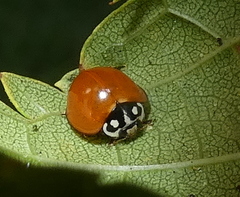
The two-spotted lady beetle is a small red beetle that usually has two black spots on its back and is entirely black underneath with black legs. It lives widely in western and central Europe and also in North America, where its numbers have dropped in many areas. Both adults and larvae eat aphids and other tiny insects; larvae can be cannibalistic, and the species is used for biological control of aphids.
Source: Wikipedia
How to recognize it
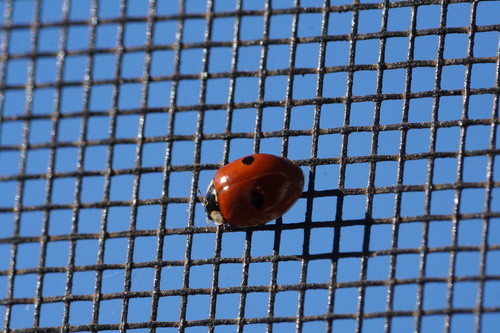
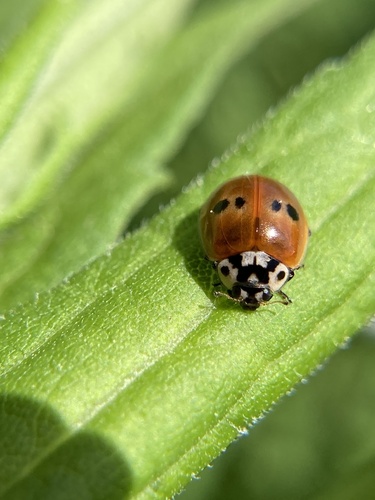
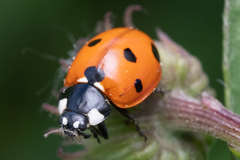
The typical form shows two black spots on a red background, and the underside of the beetle and its legs are completely black. Two white spots on the head help tell it apart from similar species that have larger white areas or more spots.
Source: Wikipedia
Size
It is a small ladybird, part of the coccinellid family.
Source: Wikipedia
How to get rid of it
It is used as a localized biological control agent against aphids in greenhouses. It was introduced to Australia specifically for aphid control.
Source: Wikipedia
Where it lives
It is also native to North America, though its populations have declined sharply in many states and provinces.
Source: Wikipedia
What it eats
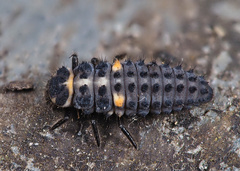
Adults feed on aphids and other small insects. Larvae are also predators of aphids but can eat each other.
Source: Wikipedia
Life cycle
Eggs are laid in clusters. A larva passes through four growth stages before pupating.
Source: Wikipedia
Where it comes from
Its native range includes western and central Europe and North America.
Source: Wikipedia
Where it is found in the US
Recorded in 45 of 51 states and DC. Most records: California, New York, Utah, Vermont, Washington, Colorado, Kentucky, Idaho.
Darker = more records. Counts are museum and citizen-science records, not population size.
Source: GBIF
Months it is reported in the US
Source: GBIF
More photos


Same family (Coccinellidae)

Sources
- Wikipedia: https://en.wikipedia.org/wiki/Adalia_bipunctata
Look it up elsewhere: GBIF · iNaturalist · BugGuide · ITIS · Wikipedia
Text written 2026-10-22 from the sources above and checked sentence by sentence against them. Data fetched 2026-10-22.