 Bug FAQ
Seven-spotted Lady Beetle
Coccinella septempunctata · Order: Coleoptera · Family: Coccinellidae
Also called: Seven-spot Ladybird Beetle, Seven-spotted Ladybird Beetle, Sevenspotted Lady Beetle
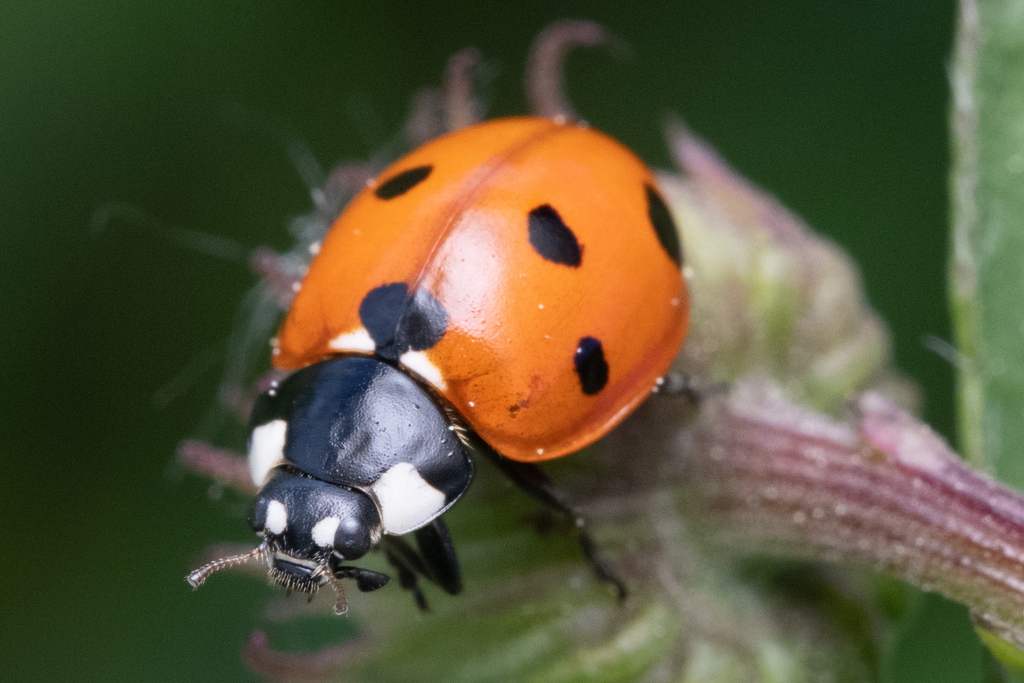
The adult is a small, oval beetle about 6.5 to 7.8 mm long and 4 mm wide, bright red with seven black spots to three on each wing and one where the wings meet. It lives in temperate regions, feeds mainly on aphids (and can survive on pollen, nectar, thrips or whitefly when aphids are scarce), and is bred for release on farms to control aphid pests. Adults hibernate in clusters, and the species is declining in some areas because invasive ladybirds outcompete it.
Source: Wikipedia
How to recognize it
The beetle’s wing covers are red with three black spots on each wing and an extra spot where the wings join, making seven spots total.
Source: Wikipedia
Size
Adults are oval, convex, about 6.5 to 7.8 mm long and roughly 4 mm wide.
Source: Wikipedia
Is it a pest in the house?
In parts of Europe its numbers are falling because the invasive harlequin ladybird outcompetes it.
Source: Wikipedia
Where it lives
It lives in many temperate-climate regions.
Source: Wikipedia
What it eats
Its main food is aphids, which it also needs for reproduction. When aphids are scarce it can eat pollen, nectar, thrips or whitefly, but it will not reproduce on those foods.
Source: Wikipedia
When you see it
Adults hibernate together in clusters for warmth and protection.
Source: Wikipedia
Where it comes from
It is one of about 5,000 ladybird species worldwide.
Source: Wikipedia
Lookalikes
The harlequin ladybird looks similar but has displaced the native seven-spotted beetle by outcompeting it and sometimes preying on it.
Source: Wikipedia
Where it is found in the US
Recorded in 51 of 51 states and DC. Most records: California, Texas, Colorado, Oregon, Washington, Virginia, North Carolina, Utah.
Darker = more records. Counts are museum and citizen-science records, not population size.
Source: GBIF
Status: introduced in North America; introduced in United States; introduced in Canada. Source: iNaturalist
Months it is reported in the US
Source: GBIF
More photos


Questions people ask
Are they good for my garden?
Yes, they eat aphids and are even bred for release to protect crops.
Source: Wikipedia
Why are they disappearing in some areas?
Invasive ladybirds like the harlequin species outcompete and sometimes prey on them.
Source: Wikipedia
Same family (Coccinellidae)

Sources
- Wikipedia: https://en.wikipedia.org/wiki/Coccinella_septempunctata
Look it up elsewhere: GBIF · iNaturalist · BugGuide · ITIS · Wikipedia
Text written 2026-10-22 from the sources above and checked sentence by sentence against them. Data fetched 2026-10-22.