 Bug FAQ
Two-banded Longhorn Beetle
Rhagium bifasciatum · Order: Coleoptera · Family: Cerambycidae


The two-banded longhorn beetle can grow up to about 22 mm long (0.87 in). Each wing cover shows two pale yellow bands, though up to seventeen pattern variations exist. It is common throughout Europe, Turkey and the Caucasus and its larvae develop in dead conifer wood for about two years.
Source: Wikipedia
How to recognize it
Two prominent pale yellow bands run across each elytron, with many pattern variants recorded.
Source: Wikipedia
Size
Adults may reach a length of roughly 22 mm (0.87 in).
Source: Wikipedia
Where it lives
Females lay eggs in dead wood, especially of coniferous trees, where the larvae tunnel for years.
Source: Wikipedia
What it eats
Adult beetles feed on a wide range of coniferous and broad-leaved trees.
Source: Wikipedia
Life cycle
After hatching in dead wood, larvae bore deep, broad tunnels and pupate after about two years.
Source: Wikipedia
More photos


Questions people ask
How can I identify a two-banded longhorn beetle?
Look for a beetle about 22 mm long with two pale yellow bands across each wing cover; many pattern variations exist.
Source: Wikipedia
Where is this beetle found?
It is common across Europe, Turkey and the Caucasus region.
Source: Wikipedia
What do the larvae eat?
The larvae develop inside dead conifer wood, boring tunnels as they grow.
Source: Wikipedia
Same family (Cerambycidae)
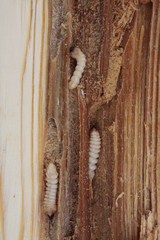 House LonghornHylotrupes bajulusCan damage your home
 Asian Longhorned BeetleAnoplophora glabripennisDamages trees, gardens or crops
 Red Milkweed BeetleTetraopes tetrophthalmus
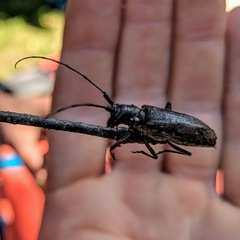 White-spotted SawyerMonochamus scutellatusCan damage your home
 Red Pine Longhorn BeetleStictoleptura rubra
 Spotted Longhorn BeetleRutpela maculataDamages trees, gardens or crops
Sources
- Wikipedia: https://en.wikipedia.org/wiki/Rhagium_bifasciatum
Look it up elsewhere: GBIF · iNaturalist · BugGuide · Wikipedia
Text written 2026-10-23 from the sources above and checked sentence by sentence against them. Data fetched 2026-10-22.