 Bug FAQ
Twin-Spot Centurion Fly
Sargus bipunctatus · Order: Diptera · Family: Stratiomyidae
Also called: Twin-spot Centurion
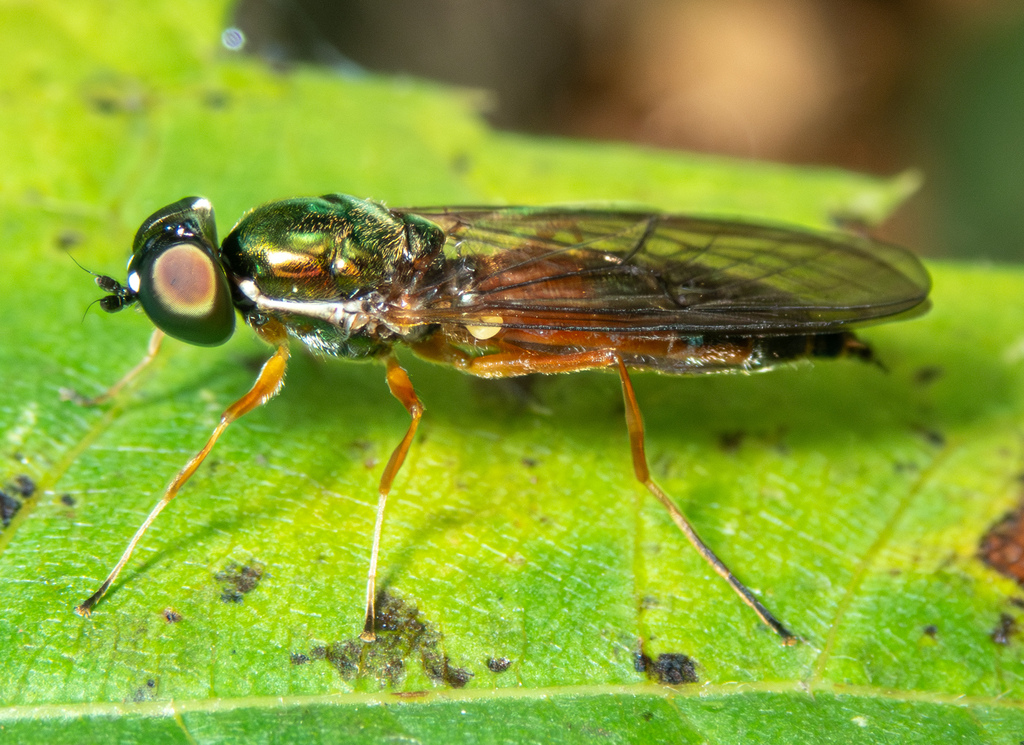
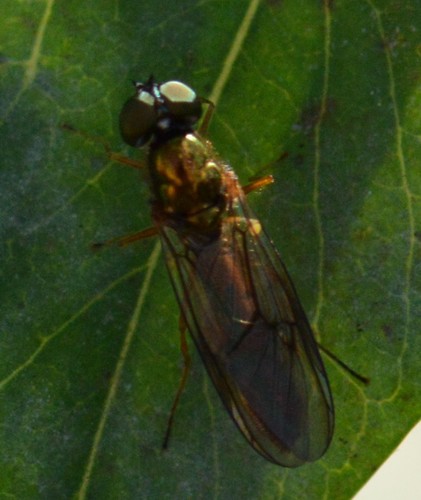
The twin-spot centurion fly is 10 to 14 mm long with a metallic green thorax and a brown abdomen that shows a violet sheen. Males are slender, females broader with a reddish base to the abdomen and a dark tip that reflects blue; the wings are faintly yellow, legs red and tarsi brown at the tips.
Source: Wikipedia
How to recognize it
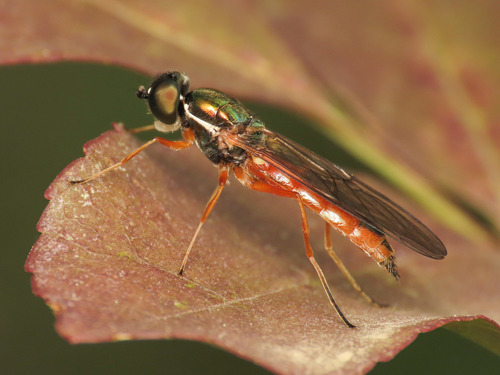
Females are broader than males, have a reddish base on the abdomen and a blackish tip with blue reflections. Wings are slightly yellow and legs are red, with the tarsi brown at the apex.
Source: Wikipedia
Size
Body length ranges from 10 to 14 mm.
Source: Wikipedia
Where it lives
They are found in open and wooded areas, often sunbathing on foliage in sheltered spots.
Source: Wikipedia
What it eats
Larvae develop in cow dung, compost, rotting vegetation, decaying fungi, and have even been found in locust egg pods.
Source: Wikipedia
When you see it
Adults are on the wing from July through November.
Source: Wikipedia
Where it comes from
Their range includes the Trans-Caucasus central belt and southern parts of western Europe.
Source: Wikipedia
Lookalikes
The frontal area is narrower than that of the similar Sargus cuprarius.
Source: Wikipedia
Where it is found in the US
Recorded in 10 of 51 states and DC. Most records: Washington, Oregon, Idaho, Utah, Montana, Massachusetts, New York, Vermont.
Darker = more records. Counts are museum and citizen-science records, not population size.
Source: GBIF
Status: introduced in Canada. Source: iNaturalist
Months it is reported in the US
Source: GBIF
More photos
Questions people ask
When can I expect to see twin-spot centurion flies?
Adults are active from July to November.
Source: Wikipedia
Where do the larvae develop?
They are found in cow dung, compost, rotting plant material, decaying fungi, and locust egg pods.
Source: Wikipedia
What do the adults look like?
They are 10 to 14 mm long, with a metallic green thorax, brown abdomen with a violet sheen, slightly yellow wings, red legs and brown-tipped tarsi; females are broader with a reddish abdomen base and a dark tip that reflects blue.
Source: Wikipedia
Same family (Stratiomyidae)



Sources
- Wikipedia: https://en.wikipedia.org/wiki/Sargus_bipunctatus
Look it up elsewhere: GBIF · iNaturalist · BugGuide · ITIS · Wikipedia
Text written 2026-10-22 from the sources above and checked sentence by sentence against them. Data fetched 2026-10-22.