 Bug FAQ
Broad Centurion Fly
Chloromyia formosa · Order: Diptera · Family: Stratiomyidae
Also called: Soldier fly, Broad Centurion
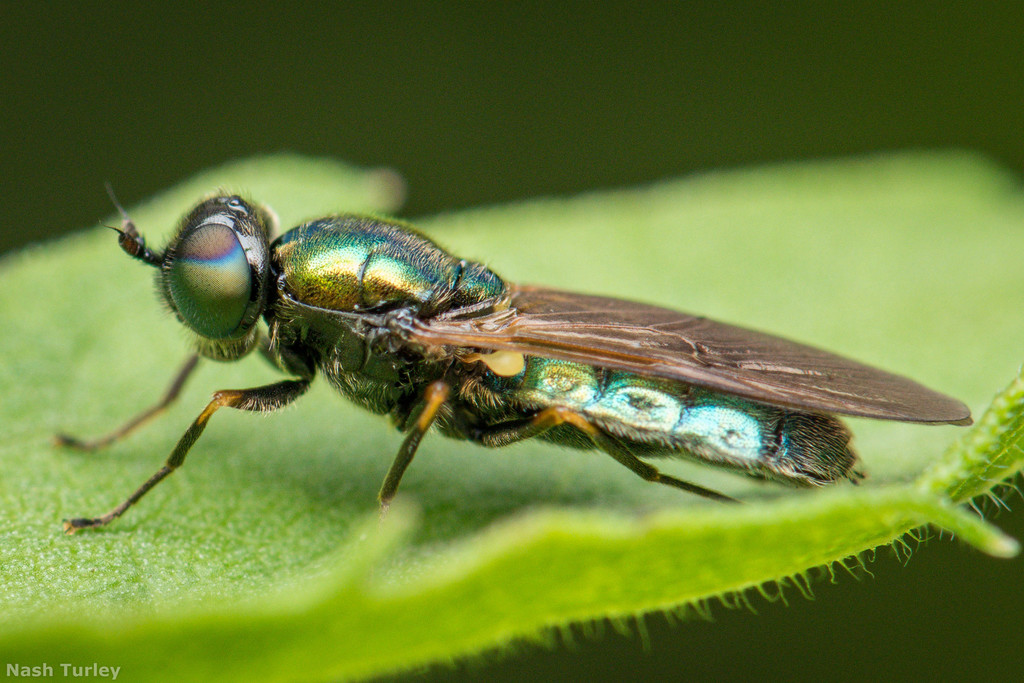
The Broad Centurion Fly is a small soldier fly about 7 to 9 mm long with a metallic green thorax and a flattened, broad abdomen that shows a blue-green sheen in females and a copper-green sheen in males. Adults are seen from April to August feeding on flower nectar and pollen, while the larvae live in rich humus soil eating decaying plant material.
Source: Wikipedia
How to recognize it
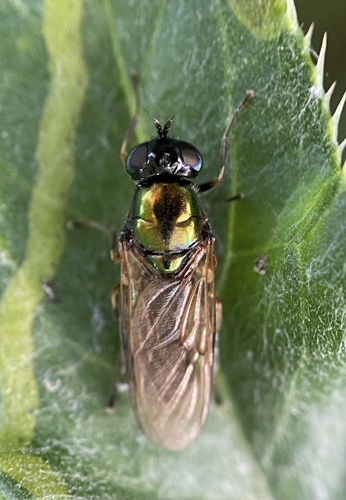
Females have a blue-green abdomen with a purple sheen, males have a copper-green sheen on the abdomen.
Source: Wikipedia
Size
Length ranges from 7.3 to 9 mm and wing length from 6 to 7 mm.
Source: Wikipedia
What it eats
Adults feed on nectar of Apiaceae flowers and pollen of Filipendula ulmaria. Larvae develop in humus-rich soil, eating dead leaves and other decaying plant matter.
Source: Wikipedia
Life cycle
Mating occurs repeatedly between April and August. Fully grown larvae overwinter before pupating.
Source: Wikipedia
When you see it
Adults are most commonly seen from April through August.
Source: Wikipedia
Where it comes from
Found across most of Europe, the Near East, the Nearctic realm and North Africa.
Source: Wikipedia
Lookalikes
It belongs to the soldier-fly family Stratiomyidae and is also called Broad centurion.
Source: Wikipedia
Where it is found in the US
Recorded in 7 of 51 states and DC. Most records: New York, Ohio, Pennsylvania, Michigan, Massachusetts, Illinois, Virginia.
Darker = more records. Counts are museum and citizen-science records, not population size.
Source: GBIF
Status: introduced in United States; introduced in Canada. Source: iNaturalist
Months it is reported in the US
Source: GBIF
More photos

Questions people ask
What do the larvae eat?
Larvae feed on dead leaves and other decaying plant material in rich soil.
Source: Wikipedia
Same family (Stratiomyidae)



Sources
- Wikipedia: https://en.wikipedia.org/wiki/Chloromyia_formosa
Look it up elsewhere: GBIF · iNaturalist · BugGuide · ITIS · Wikipedia
Text written 2026-10-22 from the sources above and checked sentence by sentence against them. Data fetched 2026-10-22.