 Bug FAQ
Tomentose Burying Beetle
Nicrophorus tomentosus · Order: Coleoptera · Family: Staphylinidae
Also called: Gold-necked carrion beetle
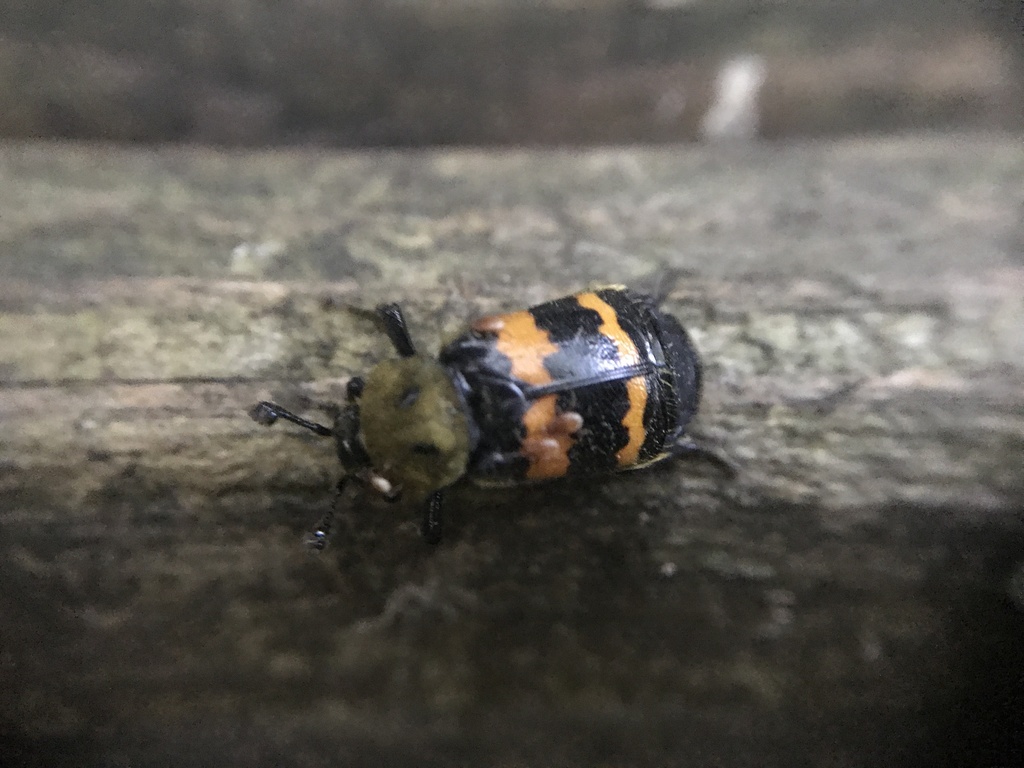
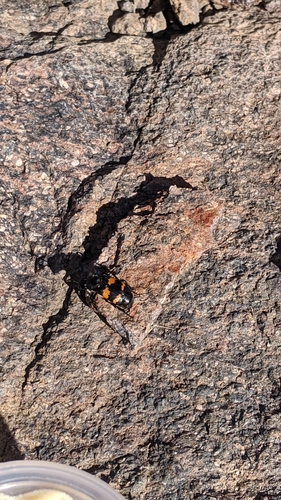
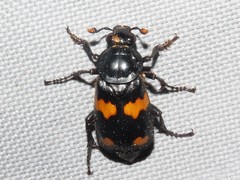
The Tomentose Burying Beetle is a small black beetle with orange spots on its wing covers and measures about 11 to 19 mm long. It lives where animal carcasses are present, such as forests, woodlands, shrublands and sandy prairies, and is active from May through October, especially in July and August. Adults and larvae feed on small vertebrate carcasses, with parents regurgitating food to the young.
Source: Wikipedia
How to recognize it
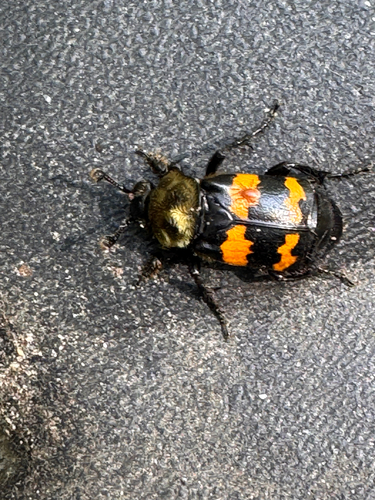
These beetles are black with orange markings on their elytra.
Source: Wikipedia
Size
They are about 11.2 to 19.0 mm long.
Source: Wikipedia
Where it lives
They are found where carcasses lie, in forests, woodlands, shrubland and sandy prairies.
Source: Wikipedia
What it eats
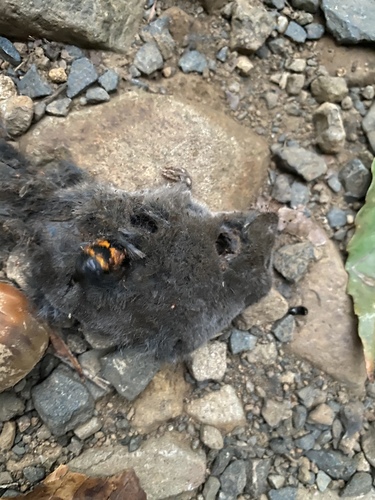
Adults eat small vertebrates such as rodents, moles and voles that they locate and bury. The larvae are fed regurgitated food from both parents and also eat directly from the carcass.
Source: Wikipedia
Life cycle
Mating starts as soon as a suitable carcass is found and buried. Eggs hatch in about four days, after which the larvae move to a feeding hole made by the parents. Both parents feed the larvae regurgitated food for six to eight days until they are fully developed. Mature beetles then locate a new carcass and repeat the cycle.
Source: Wikipedia
When you see it
They are present from May through October, with peak activity in July and August.
Source: Wikipedia
Where it comes from
They occur worldwide, but in North America they are in the United States (except the southeast) and southern Canada east of the Rockies.
Source: Wikipedia
Where it is found in the US
Recorded in 43 of 51 states and DC. Most records: Connecticut, New York, Illinois, Massachusetts, Pennsylvania, Wisconsin, Minnesota, Vermont.
Darker = more records. Counts are museum and citizen-science records, not population size.
Source: GBIF
Status: native in North America; native in Canada. Source: iNaturalist
Months it is reported in the US
Source: GBIF
More photos
Questions people ask
When are Tomentose Burying Beetles active?
They are active from May to October, especially in July and August.
Source: Wikipedia
What do Tomentose Burying Beetle larvae eat?
The larvae are fed regurgitated food by both parents and also feed directly on the buried carcass.
Source: Wikipedia
Where can I find Tomentose Burying Beetles?
They live in areas with animal carcasses such as forests, woodlands, shrublands and sandy prairies.
Source: Wikipedia
Same family (Staphylinidae)


Sources
- Wikipedia: https://en.wikipedia.org/wiki/Nicrophorus_tomentosus
Look it up elsewhere: GBIF · iNaturalist · BugGuide · ITIS · Wikipedia
Text written 2026-10-22 from the sources above and checked sentence by sentence against them. Data fetched 2026-10-22.