 Bug FAQ
Black snail beetle
Phosphuga atrata · Order: Coleoptera · Family: Staphylinidae
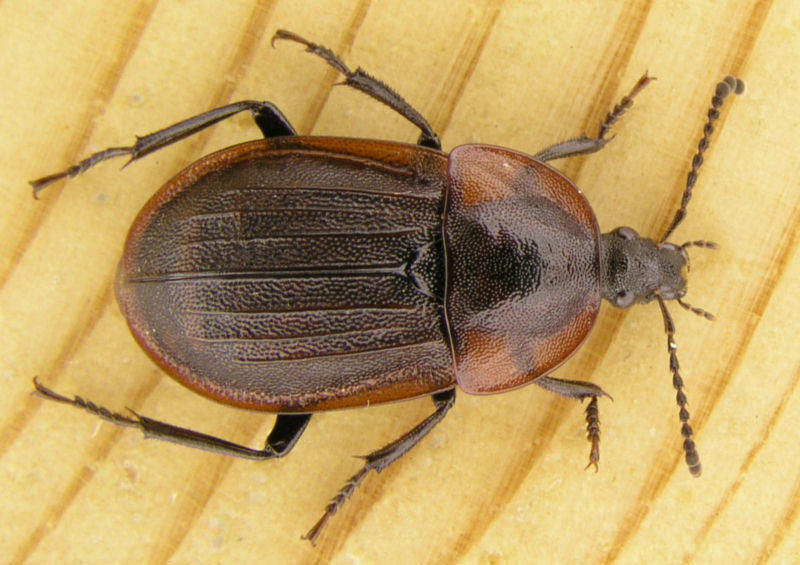
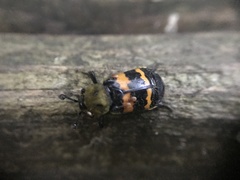
The black snail beetle grows to about 15 mm, is oval and turns from brownish to black as its shell hardens. It is active at night, hides under bark by day, and feeds on live snails, insects, earthworms and carrion; larvae also eat snails.
Source: Wikipedia
How to recognize it
Adults are oval and start brownish, becoming black as the exoskeleton hardens.
Source: Wikipedia
Size
They reach up to 15 mm in length.
Source: Wikipedia
Where it lives
They hunt at night and hide under bark during the day.
Source: Wikipedia
What it eats
Adults are flightless and eat live snails, other insects, earthworms, and carrion. Larvae are flattened, black with brown edges, and also feed on snails.
Source: Wikipedia
Life cycle
They pupate in the ground.
Source: Wikipedia
Where it comes from
They are native to Europe (including the UK), Russia, Turkey, the Caucasus, Central Asia, Mongolia, Korea, Japan, India (Kashmir), China, and parts of the Middle East.
Source: Wikipedia
Lookalikes
They look similar to beetles of the genus Silpha, which are carrion beetles.
Source: Wikipedia
Status: introduced in Canada. Source: iNaturalist
More photos


Questions people ask
What do they eat?
Adults eat live snails, insects, earthworms and carrion; larvae also feed on snails.
Source: Wikipedia
Where are they found?
They occur across Europe, Russia, parts of Asia, and the Middle East.
Source: Wikipedia
Same family (Staphylinidae)


Sources
- Wikipedia: https://en.wikipedia.org/wiki/Phosphuga
Look it up elsewhere: GBIF · iNaturalist · BugGuide · Wikipedia
Text written 2026-10-22 from the sources above and checked sentence by sentence against them. Data fetched 2026-10-22.