 Bug FAQ
American Carrion Beetle
Necrophila americana · Order: Coleoptera · Family: Staphylinidae

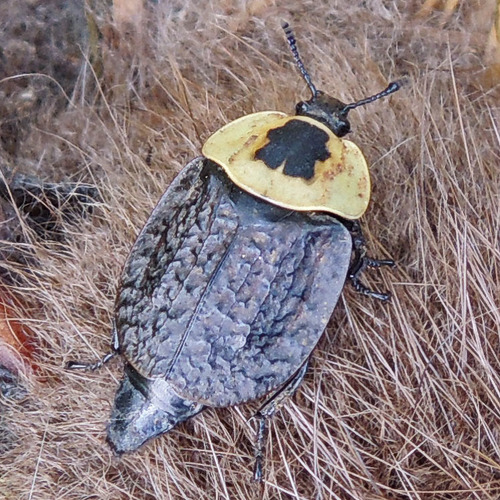
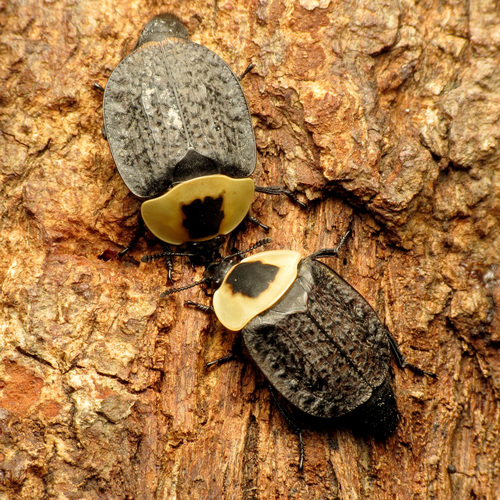
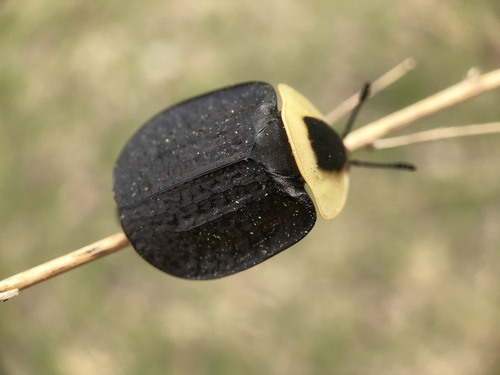
American carrion beetles are 12 to 22 mm long, with larvae growing from about 10 mm up to around 23 mm as they develop. They have a broad, flattened body and a yellow pronotum, a trait unique among North American silphids. They live in marshy, woody areas and especially in Typha marshes with lots of water.
Source: Wikipedia
How to recognize it
The beetle’s body is wide and flat with a yellow front shield (pronotum), which sets it apart from other North American carrion beetles.
Source: Wikipedia
Size
Adults are usually between 12 and 22 mm long. Larval stages range from about 10 mm in the first instar to roughly 23 mm in the final instar.
Source: Wikipedia
Where it lives
They prefer wet, marshy and wooded environments. They are also found in Typha marshes that collect a lot of water and receive heavy rain.
Source: Wikipedia
What it eats
Females lay eggs on raw flesh, and the larvae feed on that meat and on fungi. Both larvae and adults also eat fly maggots and the larvae of competing carrion beetles.
Source: Wikipedia
Life cycle
The species goes through three larval instars, each with different body sizes. From egg to adult takes roughly 10 to 12 weeks.
Source: Wikipedia
When you see it
Adults emerge from their larval stage in early summer.
Source: Wikipedia
Where it comes from
They are the only Necrophila species in North America; all others live in Asia.
Source: Wikipedia
Lookalikes
A cuckoo bumble bee (Bombus ashtoni) looks a lot like this beetle. Both the beetle and the bee appear early in the year, fly at similar times, and have comparable flight patterns.
Source: Wikipedia
Where it is found in the US
Recorded in 40 of 51 states and DC. Most records: Maryland, Virginia, Pennsylvania, Illinois, Minnesota, New York, North Carolina, Wisconsin.
Darker = more records. Counts are museum and citizen-science records, not population size.
Source: GBIF
Status: native in North America; native in Canada. Source: iNaturalist
Months it is reported in the US
Source: GBIF
More photos

Same family (Staphylinidae)

Sources
- Wikipedia: https://en.wikipedia.org/wiki/American_carrion_beetle
Look it up elsewhere: GBIF · iNaturalist · BugGuide · ITIS · Wikipedia
Text written 2026-10-22 from the sources above and checked sentence by sentence against them. Data fetched 2026-10-22.