 Bug FAQ
Tiger Spider
Trichonephila plumipes · Order: Araneae · Family: Araneidae
Also called: Humped Golden Orb-weaving Spider, Coastal Golden Orb-weaver, Golden Orb Weaver
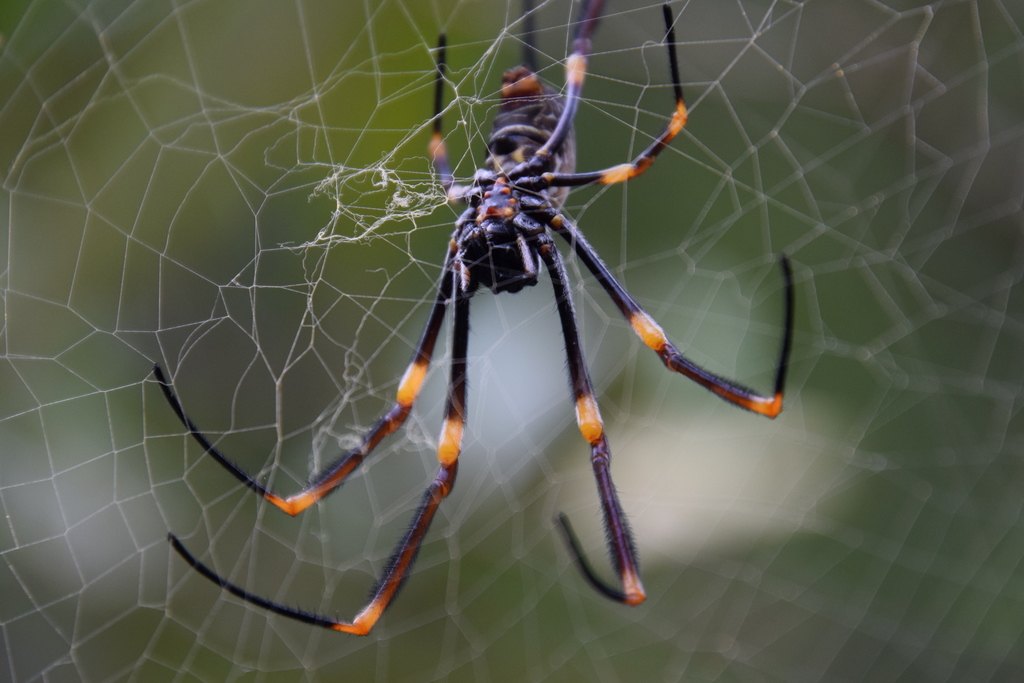
Females can grow up to 34 mm long, while males stay under 5 mm. They live in both cities and natural areas across Australia, Indonesia and nearby Pacific islands. They build orb webs, capture prey, and can survive short food shortages by eating stored catches.
Source: Wikipedia
How to recognize it
Females have a black head with silvery hairs, an olive-brown abdomen with yellow and white markings, and stiff black hair brushes on several leg pairs. Males are dark brown all over, with legs that lack the hair brushes seen on females.
Source: Wikipedia
Size
Female bodies can reach 34 mm, while males are usually under 5 mm.
Source: Wikipedia
Where it lives
They thrive in urban settings because of more food, warmth, and fewer predators. They are also common in natural landscapes.
Source: Wikipedia
What it eats
They catch insects in their webs and later eat the stored prey when food is scarce.
Source: Wikipedia
Life cycle
Eggs are laid in sacs that usually overwinter, hatch in spring, and mature by summer. In warm winters, females can lay eggs faster and produce a second generation in the same season.
Source: Wikipedia
When you see it
Warmer winters speed up egg production and allow two life cycles per year. Their active season is longer in warm conditions.
Source: Wikipedia
Lookalikes
Females look like other Trichonephila species, especially T. clavipes, because of the stiff leg hairs.
Source: Wikipedia
Where it is found in the US
Recorded in 1 of 51 states and DC. Most records: Florida.
Darker = more records. Counts are museum and citizen-science records, not population size.
Source: GBIF
More photos

Questions people ask
What do they look like?
Females have a black, silvery head, olive-brown abdomen with yellow/white spots, and stiff black hairs on some legs; males are uniformly dark brown without those brushes.
Source: Wikipedia
Where are they from?
They are native to Australia, Indonesia, New Guinea and several Pacific islands.
Source: Wikipedia
Same family (Araneidae)


Sources
- Wikipedia: https://en.wikipedia.org/wiki/Trichonephila_plumipes
Look it up elsewhere: GBIF · iNaturalist · BugGuide · ITIS · Wikipedia
Text written 2026-10-22 from the sources above and checked sentence by sentence against them. Data fetched 2026-10-22.