 Bug FAQ
Tiger longhorn
Aridaeus thoracicus · Order: Coleoptera · Family: Cerambycidae


The tiger longhorn beetle is brightly marked with orange and black colors and has orange hairs on its legs and thorax. Adults visit flowering plants for pollen and nectar in warm months, while larvae develop in dead wood. It is native to Australia and has also been introduced to New Zealand.
Source: Wikipedia
How to recognize it
It shows orange and black patterns on its body. Each leg’s femur is swollen in the middle. Orange hairs can be seen on the legs and thorax.
Source: Wikipedia
Where it lives
Adults are found on flowering plants where they feed on pollen and nectar.
Source: Wikipedia
What it eats
Adults feed on pollen and nectar, especially from plants in the myrtle family. Larvae feed on dead wood of various trees.
Source: Wikipedia
Life cycle
Larvae develop in dead wood of a variety of trees. The species was first described by Edward Donovan in 1805.
Source: Wikipedia
When you see it
Adults are most commonly seen during the warmer months.
Source: Wikipedia
Where it comes from
It is a common beetle in Australia.
Source: Wikipedia
More photos


Questions people ask
What do tiger longhorn beetles eat?
Adults feed on pollen and nectar, especially from myrtle family plants, while the larvae eat dead wood.
Source: Wikipedia
When are tiger longhorn beetles active?
They are most often seen on flowering plants during the warm months.
Source: Wikipedia
Where is the tiger longhorn beetle found?
It is common in Australia and has also been introduced to New Zealand.
Source: Wikipedia
Same family (Cerambycidae)
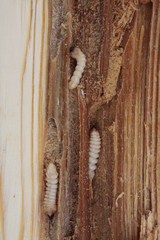 House LonghornHylotrupes bajulusCan damage your home
 Asian Longhorned BeetleAnoplophora glabripennisDamages trees, gardens or crops
 Red Milkweed BeetleTetraopes tetrophthalmus
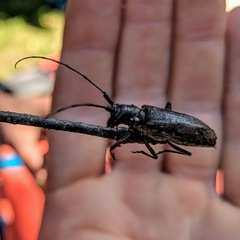 White-spotted SawyerMonochamus scutellatusCan damage your home
 Red Pine Longhorn BeetleStictoleptura rubra
 Spotted Longhorn BeetleRutpela maculataDamages trees, gardens or crops
Sources
- Wikipedia: https://en.wikipedia.org/wiki/Aridaeus_thoracicus
Look it up elsewhere: GBIF · iNaturalist · BugGuide · Wikipedia
Text written 2026-10-23 from the sources above and checked sentence by sentence against them. Data fetched 2026-10-23.