 Bug FAQ
The Tanner
Prionus coriarius · Order: Coleoptera · Family: Cerambycidae
Also called: Sawyer Beetle, Tanner Beetle
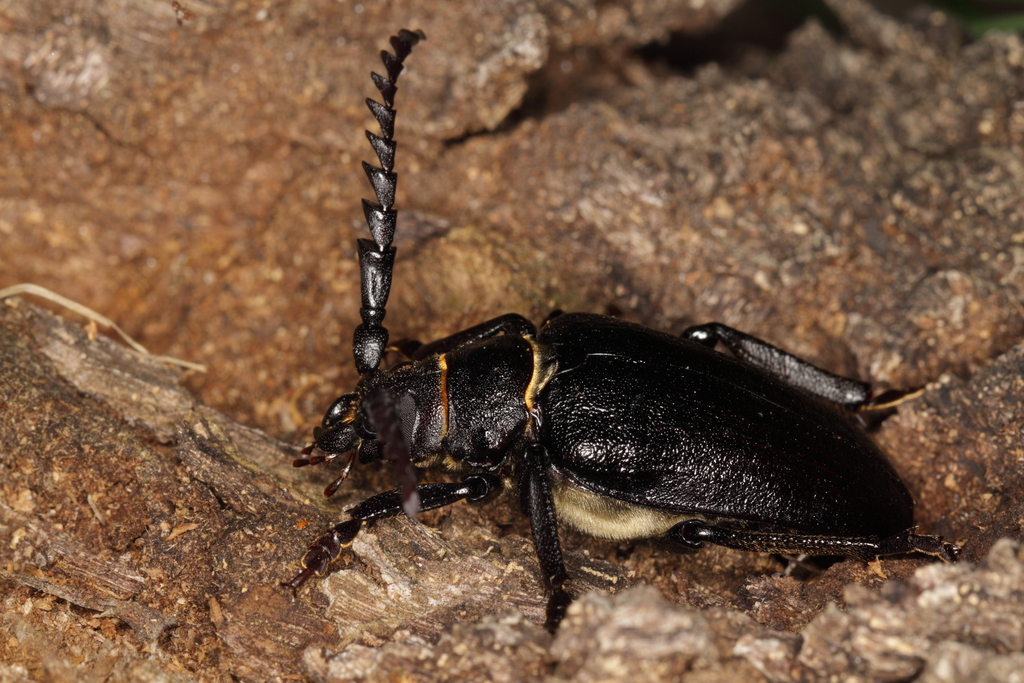
The tanner is a large, shiny dark beetle with distinctive teeth on its neck shield. Adults appear from July to September and are active at dusk and night. Its larvae live in decaying wood of both deciduous and coniferous trees and the life cycle lasts at least three years.
Source: Wikipedia
How to recognize it
The beetle’s body is glossy dark brown to black, and each side of the neck shield has three clear teeth.
Source: Wikipedia
Size
It can grow to a length of about 18 to 45 mm (0.7 to 1.8 in).
Source: Wikipedia
Where it lives
Adults are found from July through September.
Source: Wikipedia
What it eats
The larvae feed on rotting wood of both broad-leaf and conifer trees.
Source: Wikipedia
Life cycle
The species needs at least three years to complete its life cycle.
Source: Wikipedia
When you see it
Adults are active mainly in the summer months, especially at dusk and night.
Source: Wikipedia
Where it comes from
It is common across most of Europe and also occurs in North Africa and the Near East.
Source: Wikipedia
Lookalikes
It is a type of longhorn beetle sometimes called “the tanner” or “the sawyer.”
Source: Wikipedia
More photos


Same family (Cerambycidae)
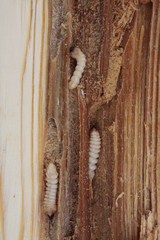 House LonghornHylotrupes bajulusCan damage your home
 Asian Longhorned BeetleAnoplophora glabripennisDamages trees, gardens or crops
 Red Milkweed BeetleTetraopes tetrophthalmus
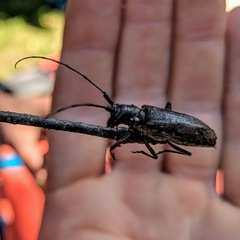 White-spotted SawyerMonochamus scutellatusCan damage your home
 Red Pine Longhorn BeetleStictoleptura rubra
 Spotted Longhorn BeetleRutpela maculataDamages trees, gardens or crops
Sources
- Wikipedia: https://en.wikipedia.org/wiki/Prionus_coriarius
Look it up elsewhere: GBIF · iNaturalist · BugGuide · Wikipedia
Text written 2026-10-22 from the sources above and checked sentence by sentence against them. Data fetched 2026-10-22.