 Bug FAQ
Steelblue Lady Beetle
Halmus chalybeus · Order: Coleoptera · Family: Coccinellidae
Also called: Steel blue ladybird beetle, steel blue lady beetle

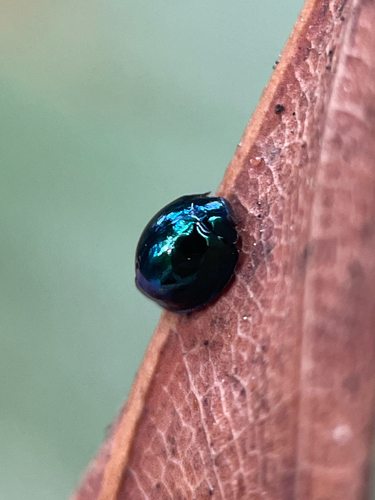
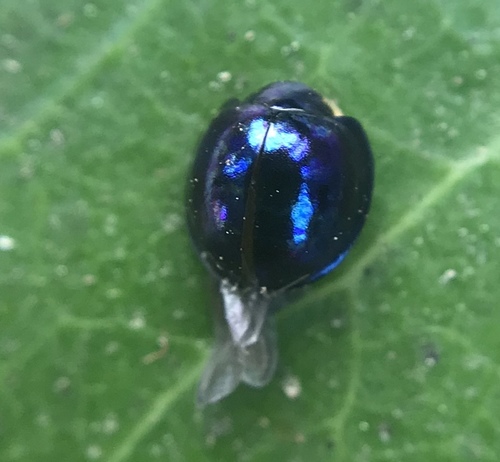
The steelblue lady beetle is a small beetle about 3 to 4 mm long with a rounded shape and a shiny blue-green colour. It comes from Australia and was brought to New Zealand to eat scale insects on citrus trees, where it now lives in the north. Both adults and larvae feed on tiny insects such as scale insects, psyllids, whitefly and gall mites.
Source: Wikipedia
How to recognize it
It has a rounded body and an iridescent blue-green colour.
Source: Wikipedia
Size
It measures roughly 3 to 4 mm in length.
Source: Wikipedia
Where it comes from
It is native to Australia.
Source: Wikipedia
Where it is found in the US
Recorded in 3 of 51 states and DC. Most records: California, Hawaii, Florida.
Darker = more records. Counts are museum and citizen-science records, not population size.
Source: GBIF
Status: introduced in United States. Source: iNaturalist
Months it is reported in the US
Source: GBIF
More photos


Questions people ask
Are they a problem for gardens or crops?
They actually feed on pest insects and were introduced to help control scale insects on citrus trees.
Source: Wikipedia
Same family (Coccinellidae)

Sources
- Wikipedia: https://en.wikipedia.org/wiki/Halmus_chalybeus
Look it up elsewhere: GBIF · iNaturalist · BugGuide · ITIS · Wikipedia
Text written 2026-10-22 from the sources above and checked sentence by sentence against them. Data fetched 2026-10-22.