 Bug FAQ
Spotted Pink Lady Beetle
Coleomegilla maculata · Order: Coleoptera · Family: Coccinellidae
Also called: Pink Spotted Lady Beetle, Spotted Lady Beetle
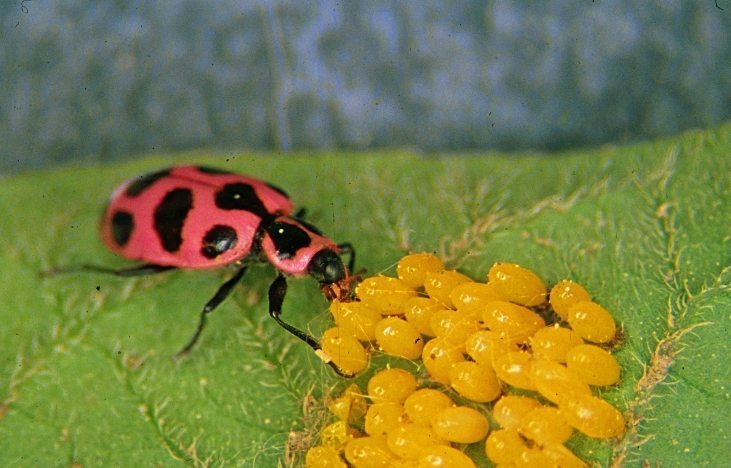
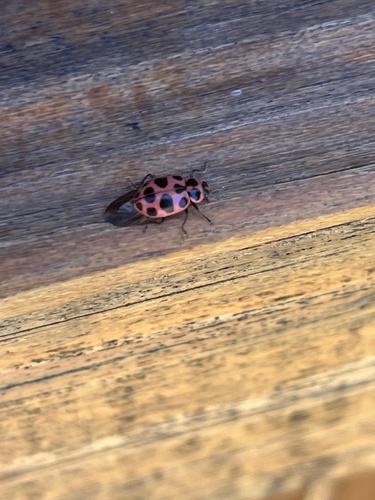
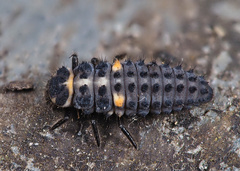
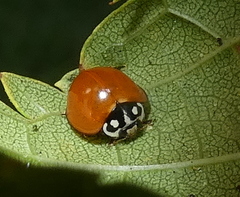
Spotted pink lady beetles are about 6 mm long, pink or orange with six black spots on each wing cover and two triangular black patches on the thorax. They live wherever aphids are found, overwinter in leaf litter or under stones, and are most abundant in September before mating and hibernation.
Source: Wikipedia
How to recognize it
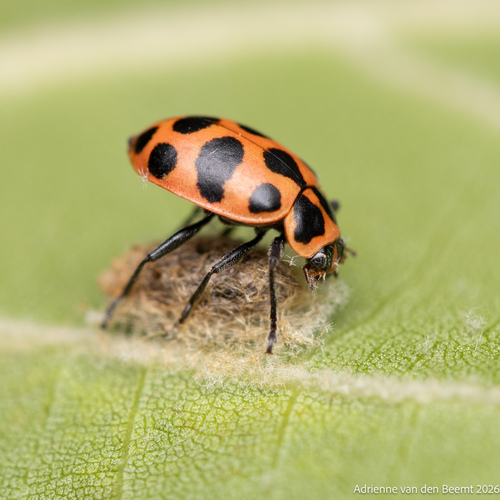
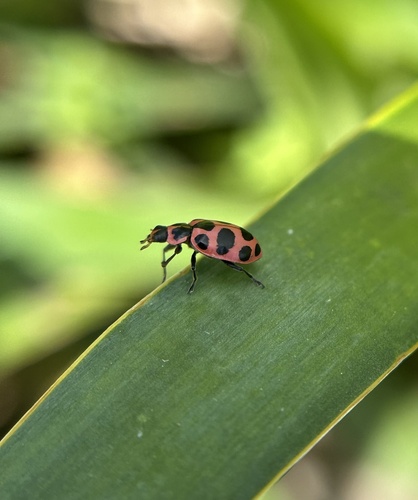
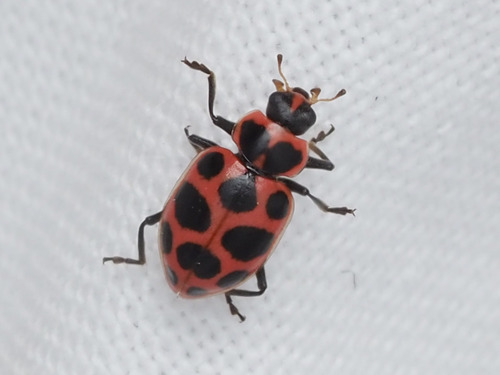
Each wing cover has six black spots and the pronotum shows two large triangular black patches. Most individuals are pink, but the subspecies C. m. fuscilabris is bright orange or red.
Source: Wikipedia
Size
The beetle is an oblong, flattened lady beetle about 6 mm (0.24 in) long.
Source: Wikipedia
Where it lives
They are found wherever their prey insects occur. In winter they gather in leaf litter, under stones or other protected spots at field edges and hedgerows.
Source: Wikipedia
What it eats
Adults and larvae mainly eat aphids. They also consume adelgids, mites, insect eggs, small larvae, pollen (up to half their intake), nectar, water and honeydew.
Source: Wikipedia
Life cycle
A female lays 200-1,000 eggs in clusters of 8-15 on stems and leaves over three months. The species produces two to five generations each year.
Source: Wikipedia
When you see it
They are most abundant in September when they gather before mating and winter hibernation. In spring they emerge, search for prey and egg-laying sites, and often walk along the ground to disperse.
Source: Wikipedia
Where it comes from
They are native across the Americas.
Source: Wikipedia
Lookalikes
They look similar to the seaside lady beetle, Naemia seriata, which lives only on coasts and has larger black markings. In Naemia seriata the apical spots on the wing covers and the pronotum markings are merged, unlike in Coleomegilla maculata.
Source: Wikipedia
Where it is found in the US
Recorded in 46 of 51 states and DC. Most records: Ohio, Vermont, Illinois, Texas, Pennsylvania, New York, Michigan, Kentucky.
Darker = more records. Counts are museum and citizen-science records, not population size.
Source: GBIF
Status: native in North America; native in Canada; native in United States. Source: iNaturalist
Months it is reported in the US
Source: GBIF
More photos
Questions people ask
Are they a pest for crops?
They actually help control aphids and other small pests, so they are beneficial rather than harmful.
Source: Wikipedia
How can I tell if I have a spotted pink lady beetle or a seaside lady beetle?
Check the size and pattern: the pink lady beetle has six small black spots per wing cover and separate triangular patches on the thorax, while the seaside lady beetle has larger, merged black markings.
Source: Wikipedia
Same family (Coccinellidae)

Sources
- Wikipedia: https://en.wikipedia.org/wiki/Coleomegilla_maculata
Look it up elsewhere: GBIF · iNaturalist · BugGuide · ITIS · Wikipedia
Text written 2026-10-22 from the sources above and checked sentence by sentence against them. Data fetched 2026-10-22.