 Bug FAQ
Spinybacked Orbweaver
Gasteracantha cancriformis · Order: Araneae · Family: Araneidae
Also called: Crab-like Spiny Orbweaver, Spiny-backed orbweaver
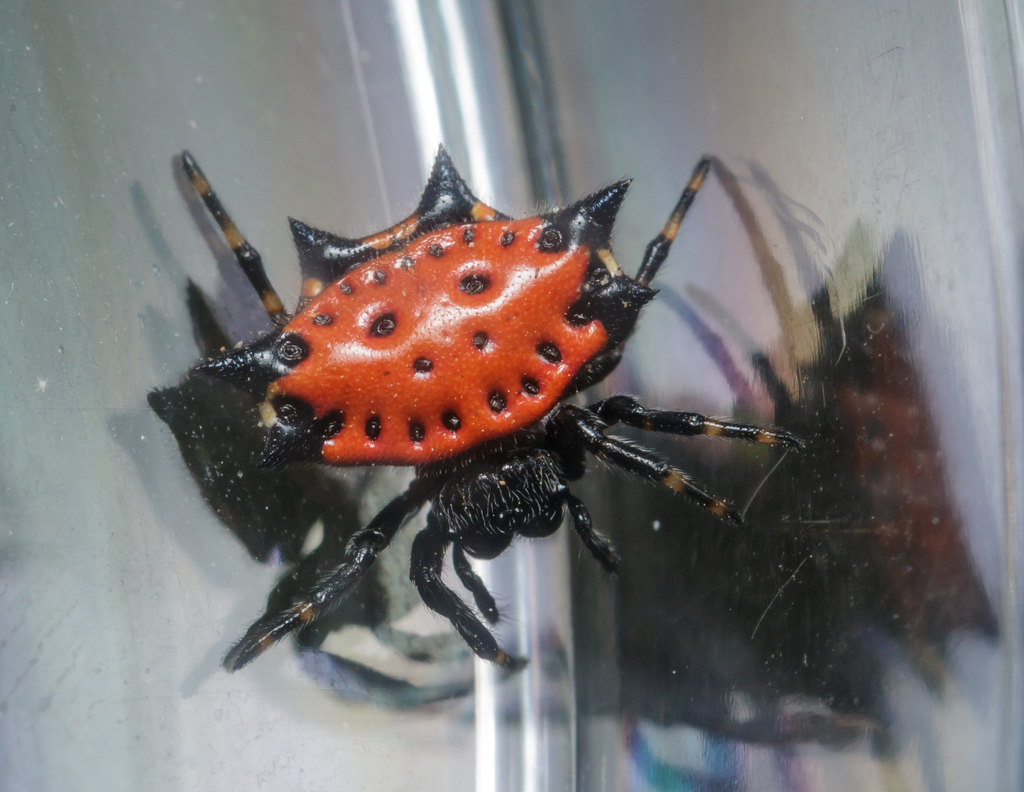
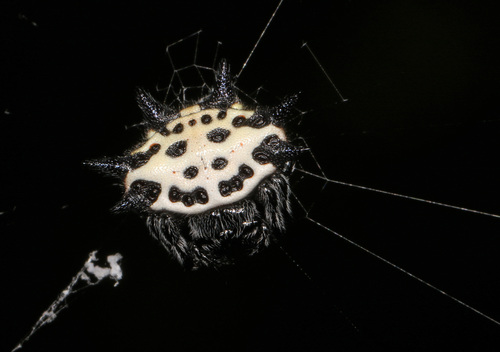
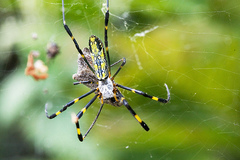
Females are about 5 to 9 mm long and 10 to 13 mm wide, while males are much smaller at 2 to 3 mm and longer than wide. They are recognized by six spine-like projections on the abdomen and a black carapace with white spots underneath. These spiders live at woodland edges and shrubby gardens, especially in citrus groves in Florida.
Source: Wikipedia
How to recognize it
The abdomen has six spine-like projections that are a key identifying feature.
Source: Wikipedia
Size
Female spinybacked orbweavers measure 5 to 9 mm in length and 10 to 13 mm in width. Males are considerably smaller, about 2 to 3 mm long and are longer than they are wide.
Source: Wikipedia
Where it lives
They prefer the edges of woodlands and shrubby garden areas. Many studies have been conducted in Florida citrus groves, indicating they are common there.
Source: Wikipedia
Life cycle
The species has a short lifespan; females die after laying an egg mass and males die about six days after sperm transfer.
Source: Wikipedia
When you see it
Reproduction typically occurs in spring after the winter when they hatch, marking the end of their life.
Source: Wikipedia
Where it is found in the US
Recorded in 27 of 51 states and DC. Most records: Florida, Texas, Alabama, North Carolina, Georgia, South Carolina, Louisiana, Virginia.
Darker = more records. Counts are museum and citizen-science records, not population size.
Source: GBIF
Status: native in North America. Source: iNaturalist
Months it is reported in the US
Source: GBIF
More photos
Same family (Araneidae)


Sources
- Wikipedia: https://en.wikipedia.org/wiki/Gasteracantha_cancriformis
Look it up elsewhere: GBIF · iNaturalist · BugGuide · ITIS · Wikipedia
Text written 2026-10-22 from the sources above and checked sentence by sentence against them. Data fetched 2026-10-22.