 Bug FAQ
Speckled longhorn beetle
Judolia cerambyciformis · Order: Coleoptera · Family: Cerambycidae
Source: Wikipedia
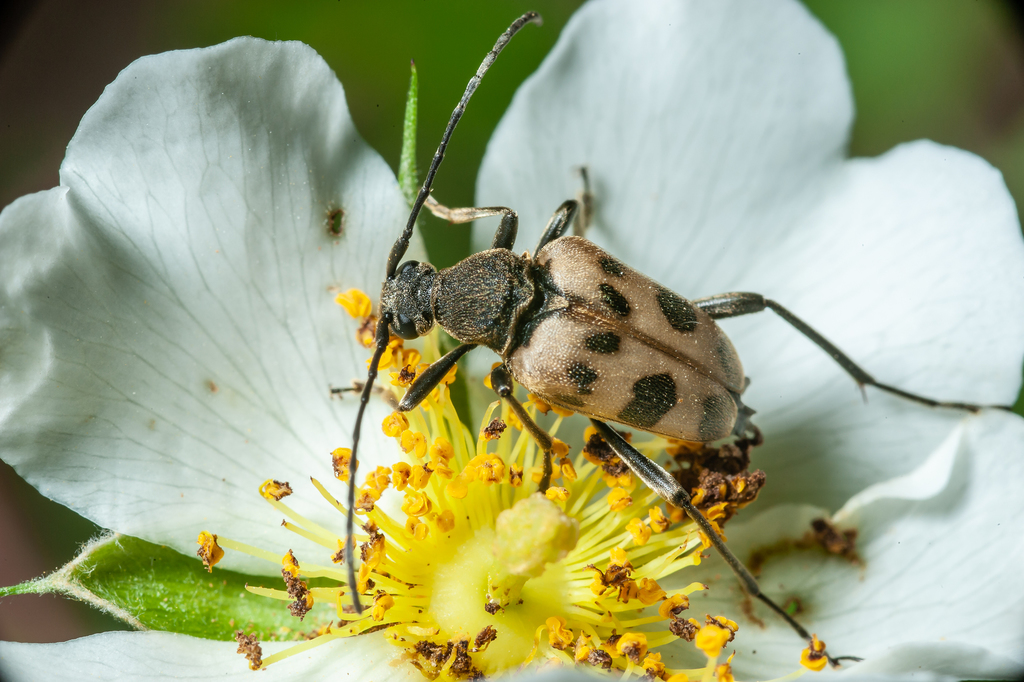
Adults are 7 to 12 mm long and have black heads, pronotums and legs with variable light brownish-yellow elytra marked by black bands. They live in hilly and mountainous areas across most of Europe and western Asia, are common in central Europe, and are seen on flowers from May to August.
Source: Wikipedia
How to recognize it
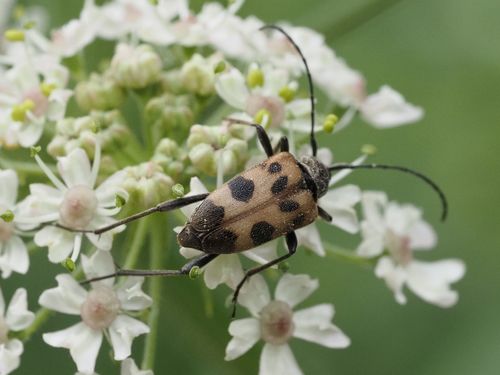
The head, pronotum and legs are black, while the wing covers are matte light brownish-yellow with usually two black transverse bands, the first often broken and the second narrower in the middle.
Source: Wikipedia
Size
They reach a length of about 7 to 12 mm.
Source: Wikipedia
Where it lives
They prefer hilly and mountainous habitats.
Source: Wikipedia
What it eats
Larvae feed on the roots of various deciduous and coniferous trees such as silver fir, Norway spruce, sweet chestnut, goat willow and ground elder.
Source: Wikipedia
Life cycle
In April or May the larvae leave their host plant and pupate in the soil, completing a two-year life cycle.
Source: Wikipedia
When you see it
Adults are commonly found on flowers from May through August.
Source: Wikipedia
Where it comes from
They occur throughout most of Europe and western Asia, but are absent from northern Europe; in central Europe they are among the most common longhorn beetles.
Source: Wikipedia
Lookalikes
It is very similar to Pachytodes erraticus, but can be distinguished by the pattern of the elytral bands.
Source: Wikipedia
More photos
Questions people ask
What do the beetle’s markings look like?
The beetle has black head, pronotum and legs, with light brownish-yellow wing covers that usually show two black transverse bands, the first often broken and the second narrower in the middle.
Source: Wikipedia
When can I see adult speckled longhorn beetles?
Adults are most often seen on flowers between May and August.
Source: Wikipedia
Where does this beetle live?
It lives in hilly and mountainous areas across most of Europe and western Asia, being common in central Europe but absent from the north.
Source: Wikipedia
Do the larvae damage trees?
Yes, the larvae feed on the roots of several tree species, which can harm those trees.
Source: Wikipedia
Same family (Cerambycidae)
 House LonghornHylotrupes bajulusCan damage your home
 Asian Longhorned BeetleAnoplophora glabripennisDamages trees, gardens or crops
 Red Milkweed BeetleTetraopes tetrophthalmus
 White-spotted SawyerMonochamus scutellatusCan damage your home
 Red Pine Longhorn BeetleStictoleptura rubra
 Spotted Longhorn BeetleRutpela maculataDamages trees, gardens or crops
Sources
- Wikipedia: https://en.wikipedia.org/wiki/Pachytodes_cerambyciformis
Look it up elsewhere: GBIF · iNaturalist · BugGuide · Wikipedia
Text written 2026-10-22 from the sources above and checked sentence by sentence against them. Data fetched 2026-10-22.