 Bug FAQ
Smoky Spreadwing
Lestes virgatus · Order: Odonata · Family: Lestidae

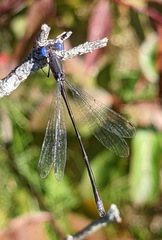
The smoky spreadwing is a damselfly with wide metallic bands on the front of its thorax and wings that are clear or uniformly yellowish. It lives in forest and woodland pools and swamps across a broad swath of southeastern Africa, from Ethiopia to South Africa.
Source: Wikipedia
How to recognize it
Its thorax has broad metallic bands near the front. The wings are either clear or uniformly yellowish, the upper anal appendages have a broad dimple before a stout tooth and are coarsely toothed behind, and its pterostigmata are small, about 1.5 to 2.0 mm.
Source: Wikipedia
Size
It is commonly called the smoky spreadwing. It is about the same size as the similarly-sized Lestes plagiatus.
Source: Wikipedia
Where it lives
It inhabits pools and swamps within forest and woodland areas.
Source: Wikipedia
Where it comes from
The species is native to much of southeastern Africa and is widespread throughout that region.
Source: Wikipedia
Lookalikes
It can be confused with the equally-sized Lestes plagiatus.
Source: Wikipedia
More photos


Questions people ask
How can I tell a smoky spreadwing apart from similar damselflies?
Look for wide metallic bands on the front of the thorax and wings that are clear or uniformly yellowish; the upper anal appendages have a distinctive broad dimple before a stout tooth and are coarsely toothed behind, and the pterostigmata are small (1.5 to 2.0 mm).
Source: Wikipedia
Where might I find a smoky spreadwing?
They live in forest and woodland pools and swamps across southeastern Africa, from Ethiopia through Kenya, Uganda, Rwanda, Malawi, Zambia, Tanzania, the DRC, Zimbabwe and down the South African coast to Cape Town.
Source: Wikipedia
Same family (Lestidae)



Sources
- Wikipedia: https://en.wikipedia.org/wiki/Lestes_virgatus
Look it up elsewhere: GBIF · iNaturalist · BugGuide · Wikipedia
Text written 2026-10-23 from the sources above and checked sentence by sentence against them. Data fetched 2026-10-23.