 Bug FAQ
Sloe Bug
Dolycoris baccarum · Order: Hemiptera · Family: Pentatomidae
Also called: Hairy Shieldbug, Sloe Shieldbug, sloe stinkbug
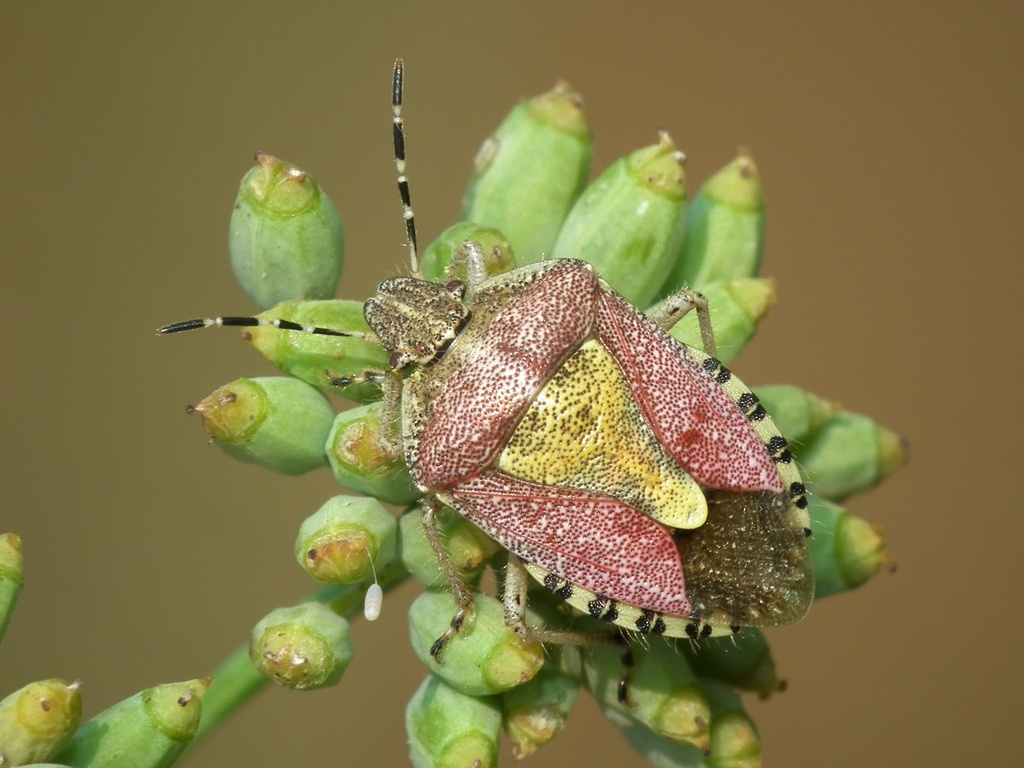
The sloe bug is a small, hairy shield bug about 10 to 12 mm long with reddish-purple wings and a mottled black-white abdomen. It lives in hedgerows, woodland edges, parks and gardens across most of Europe and Central Asia. Both nymphs and adults feed on a variety of plants, especially berries like honeysuckle and raspberries.
Source: Wikipedia
How to recognize it
The bug’s pronotum and wing covers are usually reddish-purple, the scutellum is ochre, the whole body is quite hairy, and the antennae have 4-5 black-white segments with a abdomen that shows alternating black and white patches.
Source: Wikipedia
Size
Adults are about 10 to 12.5 mm long (0.39 to 0.49 in).
Source: Wikipedia
Where it lives
They are found in hedgerows, woodland edges, fields, forests, parks and gardens.
Source: Wikipedia
What it eats
Nymphs eat many plants, especially members of the rose and aster families, as well as toadflax and white deadnettle. Adults are often seen on shrubs feeding on berries such as honeysuckle and raspberries.
Source: Wikipedia
Life cycle
In the north they have one generation per year, while in warmer southern areas they can have two. Adults overwinter, emerge in spring to mate and lay eggs, and new adults appear by the end of summer.
Source: Wikipedia
When you see it
Adults are present year-round because they overwinter.
Source: Wikipedia
Where it comes from
The species is widespread throughout most of Europe and Central Asia.
Source: Wikipedia
Lookalikes
A related European species that can be confused with it is Dolycoris numidicus.
Source: Wikipedia
More photos


Questions people ask
Where can I find sloe bugs?
Look for them in hedgerows, woodland edges, parks and gardens across Europe and Central Asia.
Source: Wikipedia
Same family (Pentatomidae)
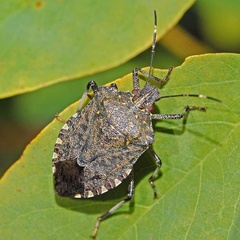 Brown Marmorated Stink BugHalyomorpha halysDamages trees, gardens or crops
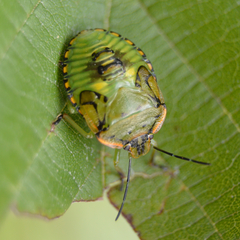 Green Stink BugChinavia hilarisDamages trees, gardens or crops
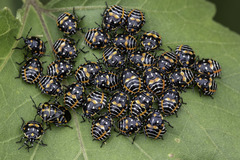 Harlequin BugMurgantia histrionicaDamages trees, gardens or crops
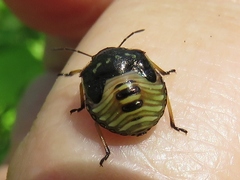 Brown Stink BugEuschistus servusDamages trees, gardens or crops
 Green Shield BugPalomena prasina
 European Striped Shield BugGraphosoma italicum
Sources
- Wikipedia: https://en.wikipedia.org/wiki/Dolycoris_baccarum
Look it up elsewhere: GBIF · iNaturalist · BugGuide · Wikipedia
Text written 2026-10-22 from the sources above and checked sentence by sentence against them. Data fetched 2026-10-22.