 Bug FAQ
Green Shield Bug
Palomena prasina · Order: Hemiptera · Family: Pentatomidae
Also called: Green Shieldbug

The green shield bug is a common European shield bug that ranges from bright green to bronze in colour and lacks distinct markings.
Source: Wikipedia
How to recognize it
Adults are uniformly coloured from bright green to bronze without noticeable patterns.
Source: Wikipedia
What it eats
They obtain nutrition by sucking sap from plants, including orchard crops like apples, pears and hazelnuts.
Source: Wikipedia
Life cycle
Adults emerge in April or May after wintering in the soil, and their colour shifts to greener-brown or bronze as summer progresses.
Source: Wikipedia
When you see it
In Europe they become visible in spring, having overwintered as adults in humus.
Source: Wikipedia
Where it comes from
The species belongs to the Palearctic region and is a member of the Pentatomidae family.
Source: Wikipedia
Lookalikes
The name can also refer to other Nezarini species, and “green stink bug” may describe the North American Chinavia hilaris.
Source: Wikipedia
More photos


Questions people ask
Are they a problem for my garden?
They feed on plant sap and can affect fruit trees such as apples and pears.
Source: Wikipedia
Same family (Pentatomidae)
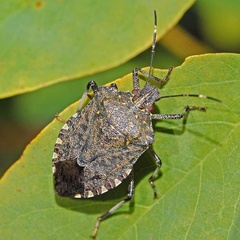 Brown Marmorated Stink BugHalyomorpha halysDamages trees, gardens or crops
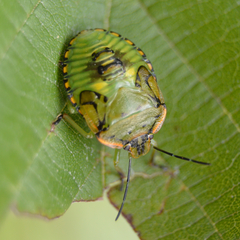 Green Stink BugChinavia hilarisDamages trees, gardens or crops
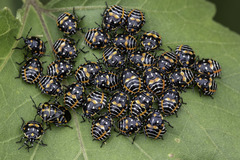 Harlequin BugMurgantia histrionicaDamages trees, gardens or crops
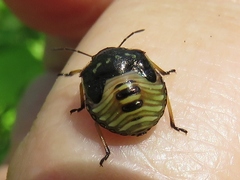 Brown Stink BugEuschistus servusDamages trees, gardens or crops
 European Striped Shield BugGraphosoma italicum
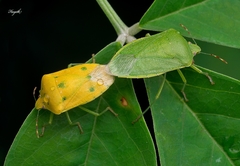 Southern Green Stink BugNezara viridula
Sources
- Wikipedia: https://en.wikipedia.org/wiki/Green_shield_bug
Look it up elsewhere: GBIF · iNaturalist · BugGuide · Wikipedia
Text written 2026-10-22 from the sources above and checked sentence by sentence against them. Data fetched 2026-10-22.