 Bug FAQ
Signature Spider
Argiope anasuja · Order: Araneae · Family: Araneidae

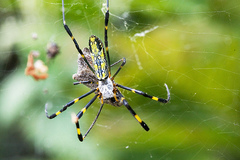
Females are about 8 to 12 mm long while males are 3.5 to 4.5 mm. The spider has a grey-brown cephalothorax with hairs, a pentagonal hairy abdomen that is yellowish on top with brown bands, and a dark underside with two white patches.
Source: Wikipedia
How to recognize it
The cephalothorax is grey-brown and hairy. The abdomen is pentagonal, hairy, yellowish on the dorsum with brown transverse bands, and has three pairs of distinct sigilla; the ventrum is dark brown with two longitudinal white patches.
Source: Wikipedia
Size
Females measure about 8 to 12 mm, males about 3.5 to 4.5 mm.
Source: Wikipedia
Where it lives
They are commonly found on flora of the Mimosaceae family. They prefer to spin their web in a plane of shadow during daylight.
Source: Wikipedia
Life cycle
Males are typically smaller than females.
Source: Wikipedia
Where it comes from
They occur from the Seychelles across India, Pakistan, Nepal, Sri Lanka, the Maldives and into Brazil.
Source: Wikipedia
Where it is found in the US
Recorded in 1 of 51 states and DC. Most records: Hawaii.
Darker = more records. Counts are museum and citizen-science records, not population size.
Source: GBIF
More photos


Questions people ask
How big are Signature Spiders?
Females are about 8 to 12 mm long and males are 3.5 to 4.5 mm.
Source: Wikipedia
Where do they usually live?
They are commonly found on plants of the Mimosaceae family and build their webs in shaded daylight areas.
Source: Wikipedia
What region are they native to?
Their range extends from the Seychelles through India, Pakistan, Nepal, Sri Lanka, the Maldives and reaches Brazil.
Source: Wikipedia
Same family (Araneidae)



Sources
- Wikipedia: https://en.wikipedia.org/wiki/Argiope_anasuja
Look it up elsewhere: GBIF · iNaturalist · BugGuide · ITIS · Wikipedia
Text written 2026-10-23 from the sources above and checked sentence by sentence against them. Data fetched 2026-10-22.