 Bug FAQ
Shamrock Orbweaver
Araneus trifolium · Order: Araneae · Family: Araneidae
Also called: Shamrock Spider, Shamrock orb-weaver

Adult female shamrock orbweavers are 9 to 20 mm long, while males are 4 to 8 mm. They spin large orb webs 0.5 to 2 m above the ground on tall herbaceous plants such as goldenrod and ironweed. They are found across the United States and Canada, from Alaska to California and from Newfoundland to Pennsylvania, with records throughout the Great Plains.
Source: Wikipedia
How to recognize it
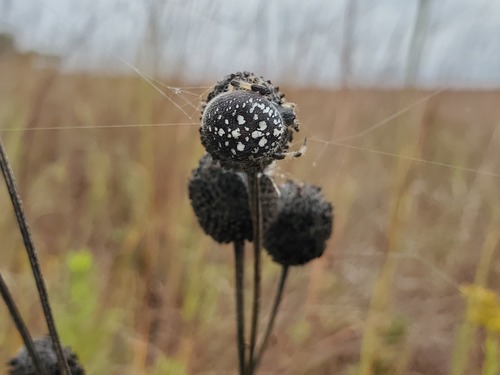
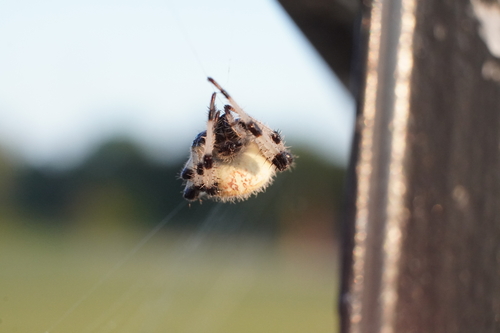
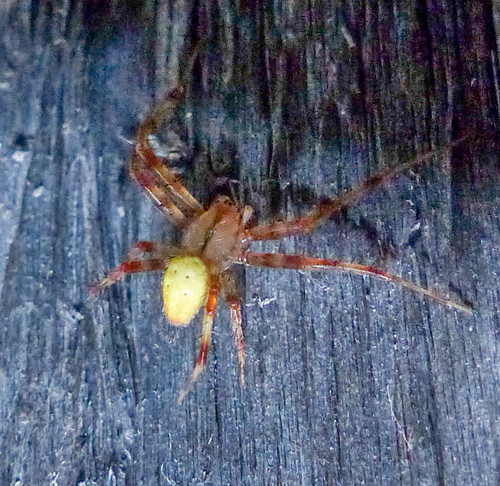
The abdomen is big, almost spherical, and can be pale white, yellow, green, maroon, or orange. The back usually shows several symmetrical pale spots.
Source: Wikipedia
Size
Females measure about 9 to 20 mm in body length. Males are smaller, about 4 to 8 mm long.
Source: Wikipedia
Where it lives
They build large orb webs typically 0.5 to 2 m above ground.
Source: Wikipedia
What it eats
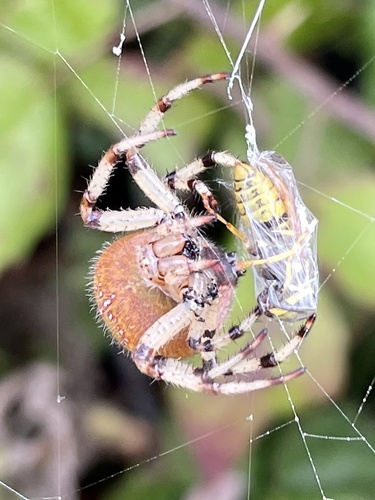
It is a sit-and-wait predator that catches a variety of flying insects. Recorded prey include grasshoppers, bees, and moths or butterflies.
Source: Wikipedia
Life cycle
Its life cycle follows the typical seasonal pattern of temperate North America. Females lay egg sacs with several hundred eggs; the species overwinters as eggs and juveniles emerge in spring.
Source: Wikipedia
When you see it
Adults mature in late summer and autumn, with most seen in September and October. Mating takes place in the autumn.
Source: Wikipedia
Where it comes from
It occurs throughout the United States and Canada.
Source: Wikipedia
Lookalikes
It may share habitats with other orb-weavers such as Argiope trifasciata. In the lab, females are identified by a long, wrinkled scape on the epigynum, typical of the diadematus group.
Source: Wikipedia
Where it is found in the US
Recorded in 33 of 51 states and DC. Most records: California, Minnesota, New York, Vermont, Wisconsin, Michigan, Ohio, Maine.
Darker = more records. Counts are museum and citizen-science records, not population size.
Source: GBIF
Status: native in North America; native in Canada; native in United States. Source: iNaturalist
Months it is reported in the US
Source: GBIF
More photos
Questions people ask
When are shamrock orbweavers most common?
They reach peak adult numbers in September and October, maturing in late summer and autumn.
Source: Wikipedia
Same family (Araneidae)


Sources
- Wikipedia: https://en.wikipedia.org/wiki/Araneus_trifolium
Look it up elsewhere: GBIF · iNaturalist · BugGuide · ITIS · Wikipedia
Text written 2026-10-23 from the sources above and checked sentence by sentence against them. Data fetched 2026-10-23.