 Bug FAQ
Ruddy Streak
Tachystola acroxantha · Order: Lepidoptera · Family: Oecophoridae
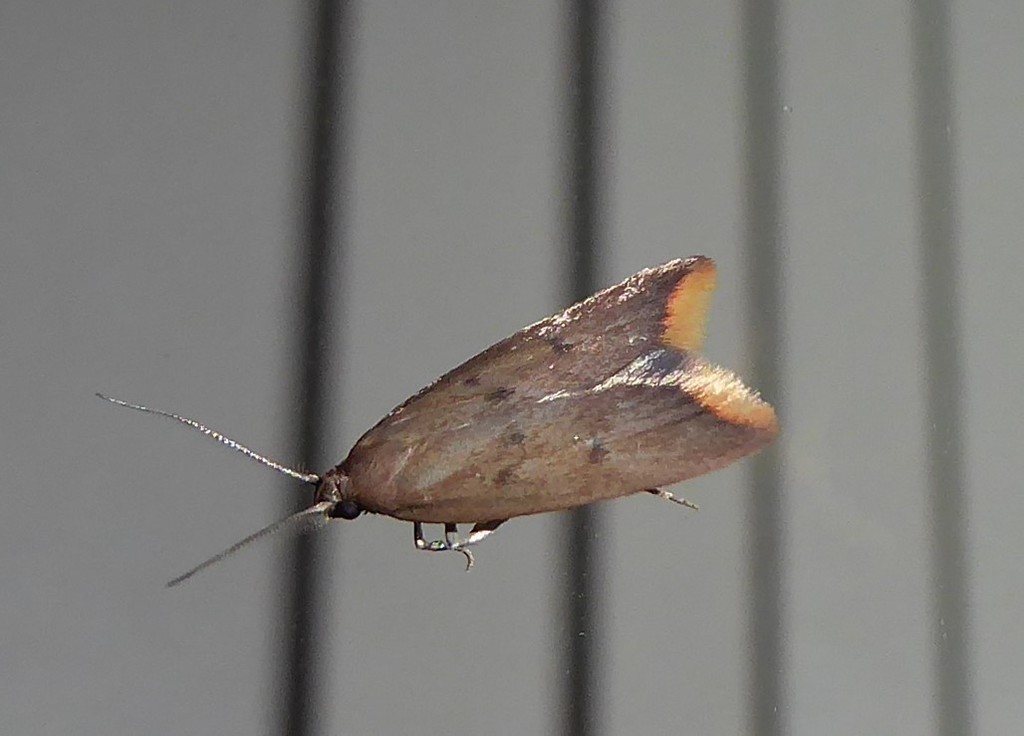
The Ruddy Streak moth has a wingspan of about 13 to 15 mm and a translucent grey-white body with a brown head. It is native to parts of Australia and in Britain it flies from late April through September, often in several generations. Larvae feed on fresh leaves, including Berberis, and are found among spun eucalyptus leaves or in the places where they feed.
Source: Wikipedia
How to recognize it
The body is a translucent grey-white to creamy white with a darker dorsal line showing the gut, and the head is brown with darker mandibles.
Source: Wikipedia
Size
Wingspan ranges from 13 to 15 mm.
Source: Wikipedia
Is it a pest in the house?
Adults are attracted to light and have been found inside a flour mill, indicating they can enter homes.
Source: Wikipedia
Where it lives
Adults are attracted to light and have been found in gardens, heathland and even in a flour mill.
Source: Wikipedia
What it eats
Larvae prefer fresh leaves and have also been recorded feeding on Berberis species.
Source: Wikipedia
Life cycle
Pupae are found in the larval feeding site, between spun leaves.
Source: Wikipedia
Where it comes from
Native to Australia, specifically New South Wales, Tasmania and Victoria.
Source: Wikipedia
More photos


Questions people ask
When are Ruddy Streak moths active?
In Britain they are on the wing from late April through September, usually in several overlapping generations.
Source: Wikipedia
What do the larvae eat?
They feed on fresh leaves, including those of Berberis plants.
Source: Wikipedia
Where might I find these moths in my garden?
Adults are attracted to light and can be found around garden lights, heath areas, and sometimes inside nearby buildings like flour mills.
Source: Wikipedia
Same family (Oecophoridae)
 Brown House MothHofmannophila pseudospretellaCan damage your home
 Orange-headed Callima MothCallima argenticinctella
 White-shouldered House MothEndrosis sarcitrellaCan damage your home
 Suzuki's Promalactis MothPromalactis suzukiella
 Izatha huttoniiIzatha huttonii
 Green lichen tuft mothIzatha peroneanella
Sources
- Wikipedia: https://en.wikipedia.org/wiki/Tachystola_acroxantha
Look it up elsewhere: GBIF · iNaturalist · BugGuide · Wikipedia
Text written 2026-10-22 from the sources above and checked sentence by sentence against them. Data fetched 2026-10-22.