 Bug FAQ
Green lichen tuft moth
Izatha peroneanella · Order: Lepidoptera · Family: Oecophoridae
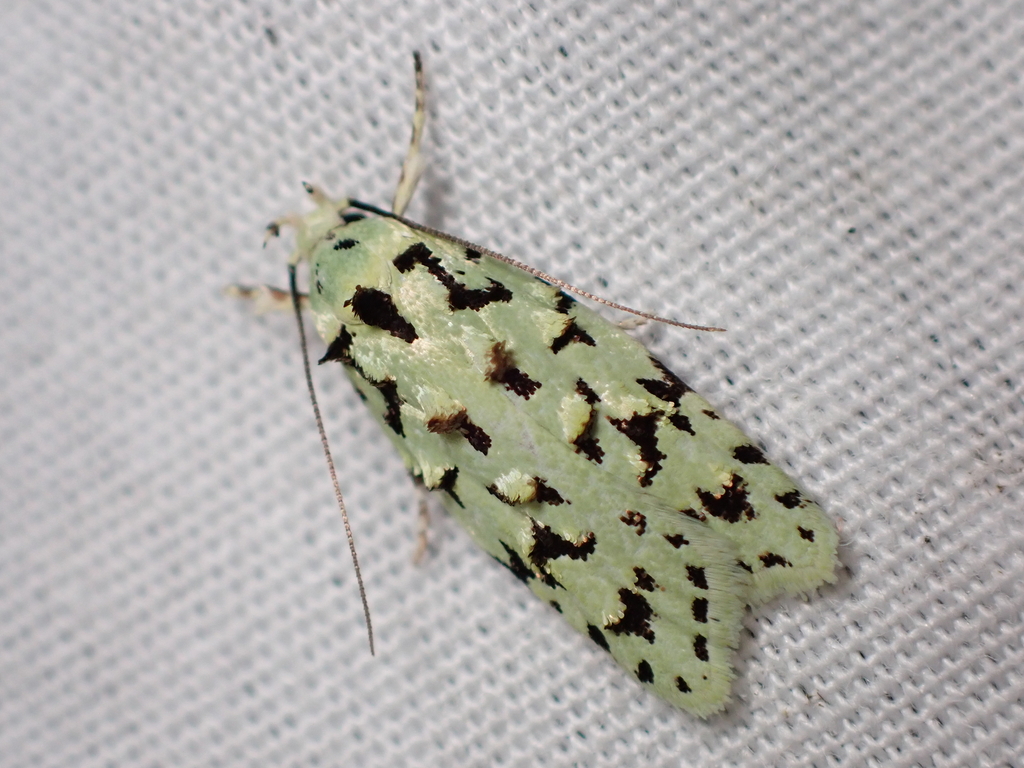
The green lichen tuft moth has a wingspan of about 15 to 25 mm in males and 17 to 30 mm in females. It shows pale green forewings with raised black-scale patches that help it blend into lichens, though the green may appear white and the black tufts can be brown in some forms. The species lives only in New Zealand and is usually seen near native forest where its larvae bore into dead wood of many native trees.
Source: Wikipedia
How to recognize it
Forewings are pale green with raised black scale patches that provide camouflage on lichens; the green can sometimes look white and the black tufts may be brown.
Source: Wikipedia
Size
Males have a wingspan of 15 to 24.5 mm and females 17 to 29.5 mm.
Source: Wikipedia
Where it lives
Adults are commonly found near native forest. Larvae feed on dead wood of various angiosperm trees, preferring standing dead trunks rather than fallen wood.
Source: Wikipedia
Life cycle
Larvae grow to about 16 mm long and pupate in early November within their wood tunnels. There is one generation each year.
Source: Wikipedia
When you see it
Adults are on the wing from September through early April. They are attracted to light and are often caught with mercury-vapour light traps.
Source: Wikipedia
Where it comes from
The moth is endemic to New Zealand.
Source: Wikipedia
Lookalikes
Izatha peroneanella is also called the small lichen moth or green lichen tuft and belongs to the Oecophoridae family.
Source: Wikipedia
Questions people ask
When can I see adult green lichen tuft moths?
Adults are active from September to early April.
Source: Wikipedia
What do the larvae feed on?
They eat dead wood of many native trees and shrubs, including species like Alseuosmia, Coprosma and Sophora.
Source: Wikipedia
Where is this moth found?
It is native and restricted to New Zealand and is usually seen near native forest.
Source: Wikipedia
How big are these moths?
Males have a wingspan of about 15 to 24.5 mm and females 17 to 29.5 mm.
Source: Wikipedia
Same family (Oecophoridae)



Sources
- Wikipedia: https://en.wikipedia.org/wiki/Izatha_peroneanella
Look it up elsewhere: GBIF · iNaturalist · BugGuide · Wikipedia
Text written 2026-10-23 from the sources above and checked sentence by sentence against them. Data fetched 2026-10-23.