 Bug FAQ
Rosy-striped Knot-horn
Oncocera semirubella · Order: Lepidoptera · Family: Pyralidae
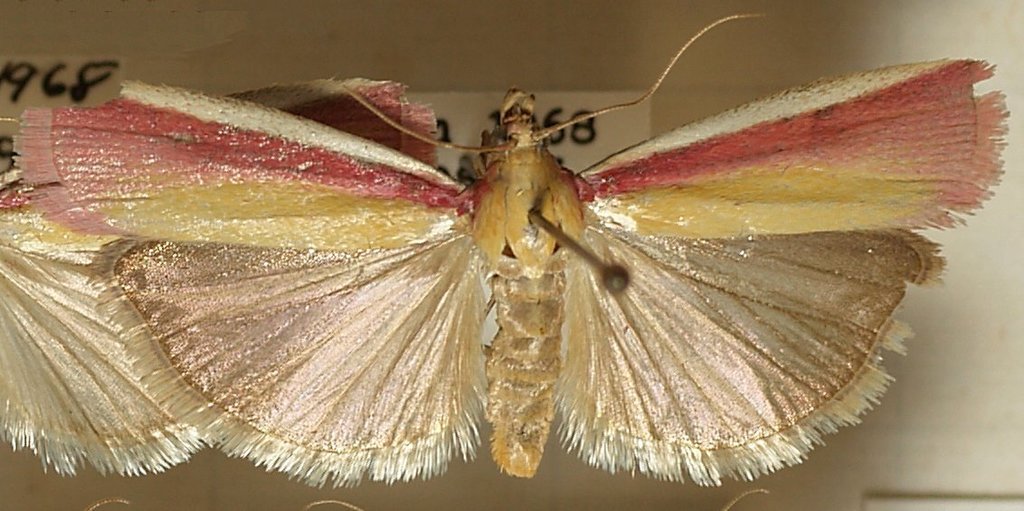
Adult moths have a 26 to 30 mm wingspan and pink-tinged forewings with a yellowish dorsal area; hindwings are grey with a slight rosy hue. They are found across Europe and East Asia, frequent short grassland, and fly from late June to August, attracted to light and sugar at dusk. The larvae feed on legumes such as bird's-foot trefoil, white clover, Ononis, horseshoe vetch and Medicago species.
Source: Wikipedia
How to recognize it
Forewings are light crimson or pink, often mixed with grey, and have a whitish-greyish-ochreous costal streak plus a broad ochreous-yellowish dorsal wash; hindwings are grey with a faint rosy tint.
Source: Wikipedia
Size
The wingspan ranges from 26 to 30 mm.
Source: Wikipedia
Where it lives
It is easily disturbed in short grassland.
Source: Wikipedia
What it eats
Larvae feed on bird's-foot trefoil, white clover, Ononis species, horseshoe vetch and various Medicago species.
Source: Wikipedia
Life cycle
Adults fly in a single generation from the end of June through August.
Source: Wikipedia
When you see it
They are active from late June to August, flying after dusk and are attracted to light and sugar.
Source: Wikipedia
Questions people ask
When will I see them?
Adults are on the wing from late June to August, especially after dusk, and are attracted to lights and sugary baits.
Source: Wikipedia
Same family (Pyralidae)
 Indian-Meal MothPlodia interpunctellaCan damage your home
 Greater Wax MothGalleria mellonella
 Mediterranean Flour MothEphestia kuehniellaCan damage your home
 Meal mothPyralis farinalisDamages trees, gardens or crops
 Bee MothAphomia sociellaNuisance, not dangerous
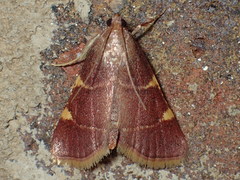 Yellow-fringed Dolichomia MothHypsopygia olinalis
Sources
- Wikipedia: https://en.wikipedia.org/wiki/Oncocera_semirubella
Look it up elsewhere: GBIF · iNaturalist · BugGuide · Wikipedia
Text written 2026-10-22 from the sources above and checked sentence by sentence against them. Data fetched 2026-10-22.