 Bug FAQ
Indian-Meal Moth
Plodia interpunctella · Order: Lepidoptera · Family: Pyralidae
Also called: Flour Moth, Grain Moth, Pantry Moth, Weevil Moth
Source: Wikipedia
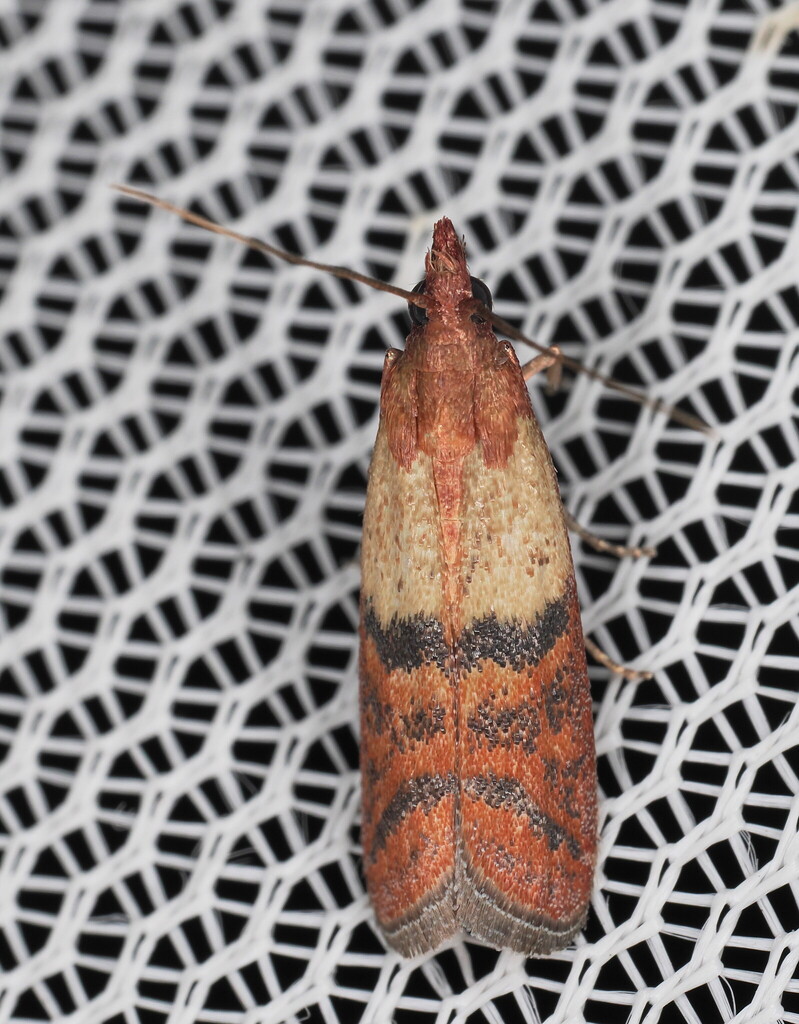
Adult Indian-meal moths are about 8 to 10 mm long with a wingspan of 16 to 20 mm and have reddish-brown forewings that fade to yellow-gray near the body, while the hindwings are gray. They are a worldwide pantry pest, especially common in tropical areas like Florida, and their larvae feed on grains, cereals, fruits and can also live on fabrics. Biological control options include the parasitoid wasp Habrobracon hebetor and baculovirus sprays, both of which target the larvae.
Source: Wikipedia
How to recognize it
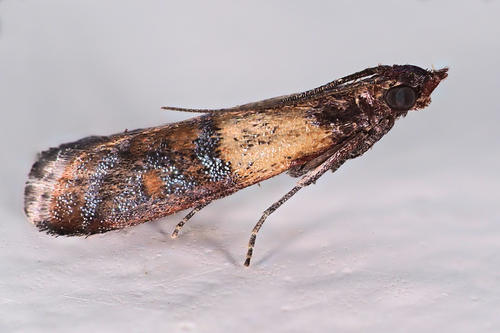
The front wings are mostly reddish-brown with a copper shine, turning yellow-gray near the body and marked by a dark band; the back wings are uniformly gray.
Source: Wikipedia
Size
Adults measure 8 to 10 mm in length and have a wingspan of 16 to 20 mm.
Source: Wikipedia
Is it a pest in the house?
They can reproduce and pupate on clothing, so fabrics are a common source of reinfestation.
Source: Wikipedia
How to get rid of it
The parasitoid wasp Habrobracon hebetor locates larvae, paralyzes them with a sting, and its offspring consume the host. Baculoviruses, insect-specific DNA viruses, are used as biological control agents and can reduce egg viability at sub-lethal doses.
Source: Wikipedia
Where it lives
They occur on every continent in tropical habitats, especially in Florida, and are common in grain storage facilities worldwide.
Source: Wikipedia
What it eats
The larvae, often called waxworms, feed on grains, cereals, fruits and similar stored products.
Source: Wikipedia
Life cycle
The final larval stage can travel far before pupating, and the species can also reproduce on clothing, so fabrics must be checked to stop reinfestation.
Source: Wikipedia
When you see it
Adults make long-distance foraging flights at twilight, attracted by blue light rather than UV.
Source: Wikipedia
Where it comes from
Despite the name, they are not native to India; the name refers to the Indian meal (cornmeal) they feed on.
Source: Wikipedia
Where it is found in the US
Recorded in 51 of 51 states and DC. Most records: Texas, California, Arizona, New York, Oregon, Massachusetts, Pennsylvania, Ohio.
Darker = more records. Counts are museum and citizen-science records, not population size.
Source: GBIF
Status: introduced in North America; introduced in United States. Source: iNaturalist
Months it is reported in the US
Source: GBIF
More photos

Questions people ask
How can I get rid of an Indian-meal moth infestation?
Use biological controls such as the parasitoid wasp Habrobracon hebetor or baculovirus sprays, and inspect all stored food and clothing.
Source: Wikipedia
What foods do Indian-meal moth larvae eat?
They feed on grains, cereals, flour, cornmeal and also on fruits and similar pantry items.
Source: Wikipedia
Can they infest my clothes?
Yes, they can reproduce and pupate on clothing, so fabrics must be inspected and cleaned.
Source: Wikipedia
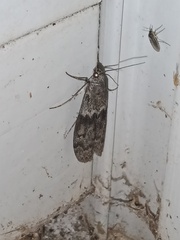
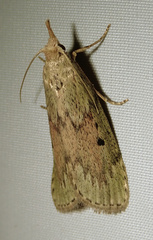
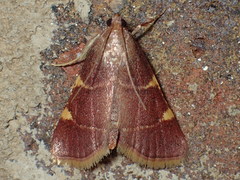
Same family (Pyralidae)


Sources
- Wikipedia: https://en.wikipedia.org/wiki/Indianmeal_moth
Look it up elsewhere: GBIF · iNaturalist · BugGuide · Wikipedia
Text written 2026-10-22 from the sources above and checked sentence by sentence against them. Data fetched 2026-10-22.