 Bug FAQ
Meal moth
Pyralis farinalis · Order: Lepidoptera · Family: Pyralidae
Source: Wikipedia
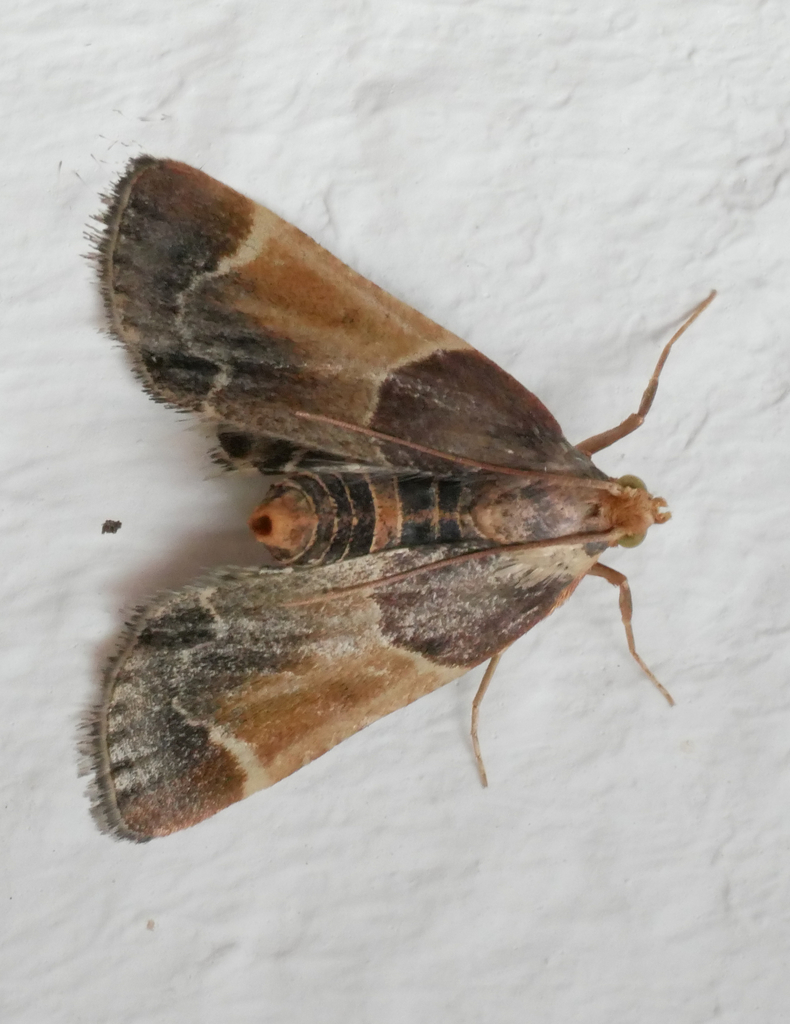
Meal moths are small, colorful moths with a wingspan of 18 to 30 mm and rest with their abdomen tip at a right angle to the body. They live in poorly stored grain silos, almond orchard detritus, and other moist grain environments, and the larvae eat cereals, grain parts, and vegetables. The species completes its life cycle in about eight weeks, can produce four generations a year, and adults fly from June to August, making them fast-reproducing pests of stored grain.
Source: Wikipedia
How to recognize it
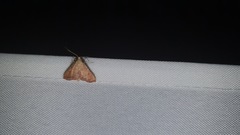
At rest, adult meal moths hold the tip of their abdomen at a 90° angle to their body.
Source: Wikipedia
Size
Their upper wings are fairly colorful for moths and measure 18 to 30 mm across.
Source: Wikipedia
Is it a pest in the house?
Because they eat cereals and grains, they are considered pests by agriculturists. Improperly stored grain can suffer considerable damage from a colony of meal moths.
Source: Wikipedia
Where it lives
They also occur in non-urban areas such as almond orchards, living in detritus.
Source: Wikipedia
What it eats
Caterpillars feed mainly on cereals but will also eat other grains, potatoes, and any part of a cereal seed such as bran, husk, or straw.
Source: Wikipedia
Life cycle
The full life cycle takes about eight weeks, allowing up to four generations per year. Rapid life cycles let populations grow quickly.
Source: Wikipedia
When you see it
Adults are on the wing from June through August.
Source: Wikipedia
Where it comes from
Meal moths have a cosmopolitan distribution, occurring across most of the world, especially along the eastern United States coast.
Source: Wikipedia
Lookalikes
Meal moth is the type species of its genus, tribe, subfamily, and family.
Source: Wikipedia
Where it is found in the US
Recorded in 50 of 51 states and DC. Most records: California, New York, Pennsylvania, Ohio, Massachusetts, Virginia, North Carolina, Maryland.
Darker = more records. Counts are museum and citizen-science records, not population size.
Source: GBIF
Status: introduced in North America; introduced in United States; introduced in Canada. Source: iNaturalist
Months it is reported in the US
Source: GBIF
More photos

Questions people ask
How can I prevent meal moth damage in my pantry?
Store grain and cereal products in airtight containers and keep storage areas dry to deny the moths a suitable habitat.
Source: Wikipedia
When are adult meal moths active?
Adult moths are active and flying from June through August.
Source: Wikipedia
What do meal moth larvae eat?
The larvae feed on cereals, grain parts like bran and husk, and can also eat vegetables such as potatoes.
Source: Wikipedia
Same family (Pyralidae)

Sources
- Wikipedia: https://en.wikipedia.org/wiki/Pyralis_farinalis
Look it up elsewhere: GBIF · iNaturalist · BugGuide · Wikipedia
Text written 2026-10-22 from the sources above and checked sentence by sentence against them. Data fetched 2026-10-22.