 Bug FAQ
Ropalidia marginata
Ropalidia marginata · Order: Hymenoptera · Family: Vespidae
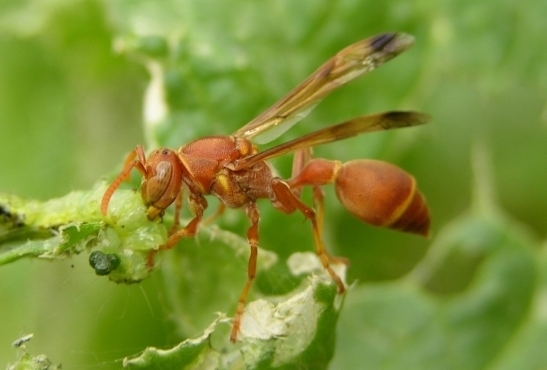
Females feed larvae by masticating solid food, while males can also feed larvae when females are absent.
Source: Wikipedia
How to recognize it
Males have weaker mandibles and no stinger, unlike females.
Source: Wikipedia
Size
R. marginata has a dark reddish body with yellow markings as described above.
Source: Wikipedia
Does it bite or sting?
Males lack a stinger and have weaker mandibles, while females can defend nests by chasing and sometimes stinging predators or intruders.
Source: Wikipedia
Where it lives
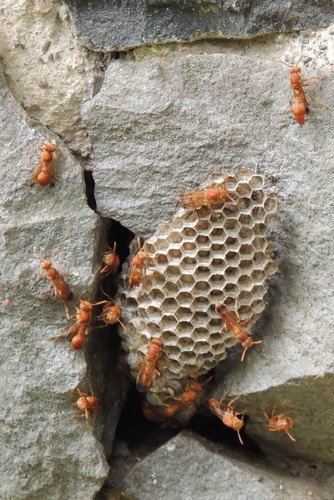
It is the most common social wasp in India.
Source: Wikipedia
What it eats
Females chew solid food for several minutes before feeding larvae.
Source: Wikipedia
Life cycle
Males are produced less often and in smaller numbers than females.
Source: Wikipedia
Lookalikes
It resembles other dark reddish wasps with yellow joint spots and a yellow abdominal ring.
Source: Wikipedia
More photos
Questions people ask
How can I tell a male Ropalidia marginata from a female?
Males have weaker mandibles and no stinger, while females have a functional stinger.
Source: Wikipedia
Same family (Vespidae)


Sources
- Wikipedia: https://en.wikipedia.org/wiki/Ropalidia_marginata
Look it up elsewhere: GBIF · iNaturalist · BugGuide · Wikipedia
Text written 2026-10-23 from the sources above and checked sentence by sentence against them. Data fetched 2026-10-22.