 Bug FAQ
Retrachydes thoracicus
Retrachydes thoracicus · Order: Coleoptera · Family: Cerambycidae
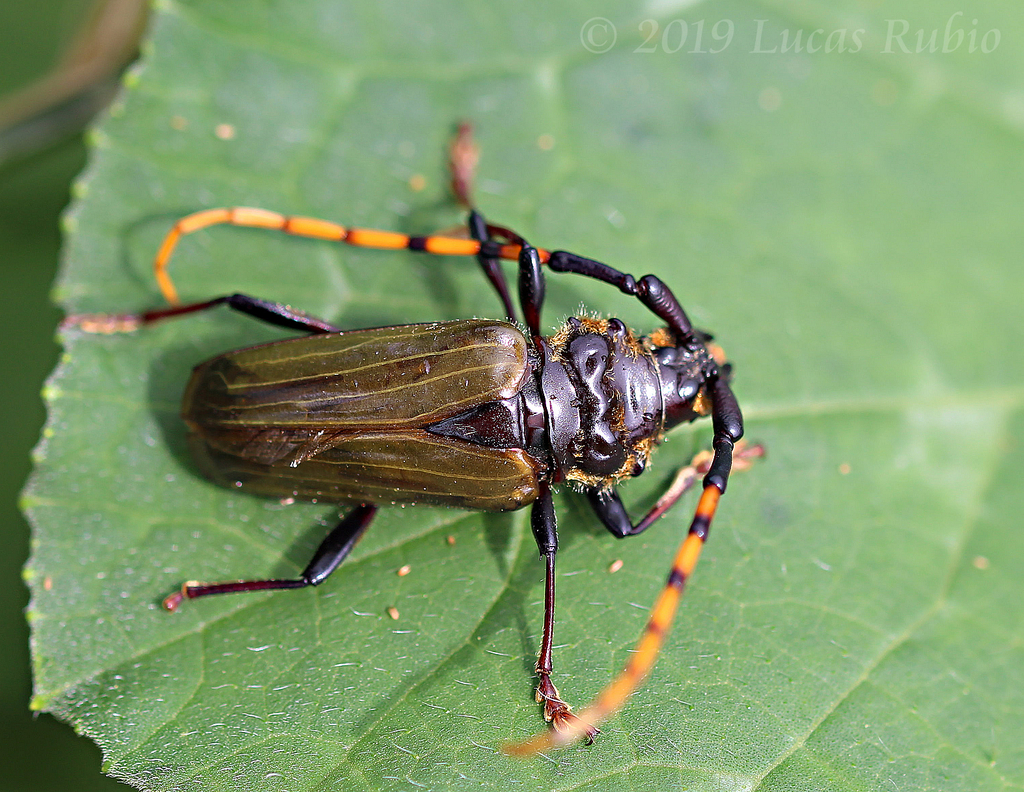
It grows to about 1.7 to 3.3 cm long. Its back is covered in dense tiny hairs, the pronotum is humped across, and its long antennae have orange bands. It lives in several South American countries, including Argentina, Brazil, Uruguay, Paraguay and Bolivia.
Source: Wikipedia
How to recognize it
The beetle has a humped pronotum and orange-banded long antennae. Its body is covered densely with fine hairs.
Source: Wikipedia
Size
Adults range from about 16.5 mm to 33 mm in length.
Source: Wikipedia
Where it lives
It is found in South America.
Source: Wikipedia
Where it comes from
Its range includes Argentina, Brazil, Uruguay, Paraguay and Bolivia.
Source: Wikipedia
More photos
Questions people ask
What does Retrachydes thoracicus look like?
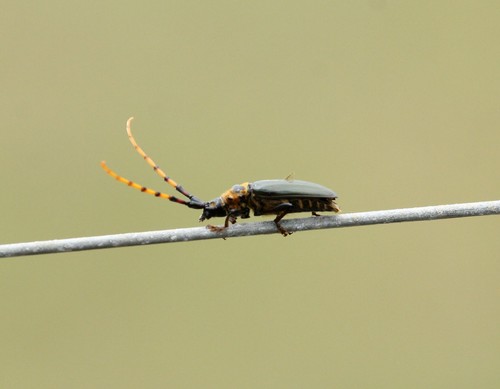
It has a humped pronotum, orange-banded long antennae, and a densely hairy body.
Source: Wikipedia
Where is this species found?
It occurs in Argentina, Brazil, Uruguay, Paraguay and Bolivia in South America.
Source: Wikipedia
Same family (Cerambycidae)
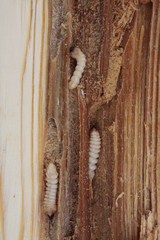 House LonghornHylotrupes bajulusCan damage your home
 Asian Longhorned BeetleAnoplophora glabripennisDamages trees, gardens or crops
 Red Milkweed BeetleTetraopes tetrophthalmus
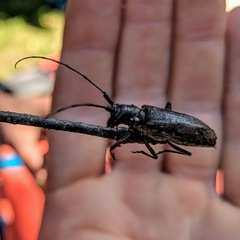 White-spotted SawyerMonochamus scutellatusCan damage your home
 Red Pine Longhorn BeetleStictoleptura rubra
 Spotted Longhorn BeetleRutpela maculataDamages trees, gardens or crops
Sources
- Wikipedia: https://en.wikipedia.org/wiki/Retrachydes
Look it up elsewhere: GBIF · iNaturalist · BugGuide · Wikipedia
Text written 2026-10-23 from the sources above and checked sentence by sentence against them. Data fetched 2026-10-23.