 Bug FAQ
Locust Borer
Megacyllene robiniae · Order: Coleoptera · Family: Cerambycidae
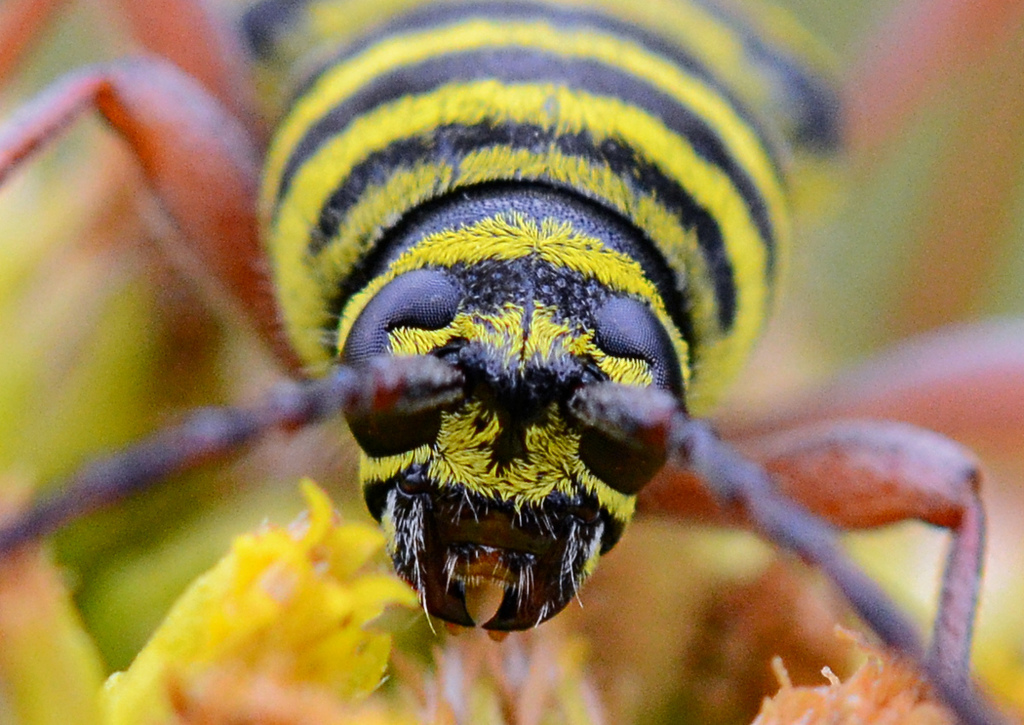
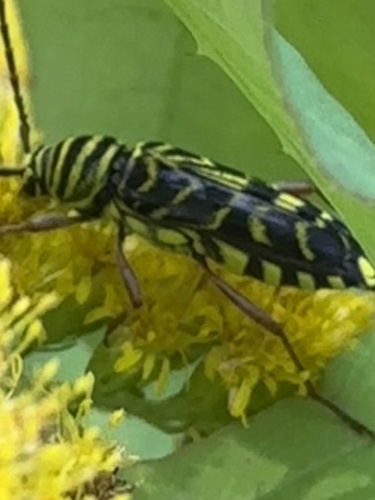
Adult locust borers are 11 to 28 mm long, black and yellow striped, and can be confused with wasps. They live on black locust trees, lay eggs in bark crevices in fall, and the larvae develop inside the tree before emerging as adults in late summer. Adults feed on goldenrod pollen and are most active from August through October.
Source: Wikipedia
How to recognize it
From a distance the beetle looks like a wasp or bee because of its black and yellow stripes. A distinctive W-shaped third stripe runs across its wing covers.
Source: Wikipedia
Size
Adults measure between 11 and 28 mm in length. Full-grown larvae are legless, white, and about 25 mm long.
Source: Wikipedia
Is it a pest in the house?
It is a serious pest of black locust trees (Robinia pseudoacacia).
Source: Wikipedia
Where it lives
They are found wherever unprotected black locust trees grow, often in fields and meadows.
Source: Wikipedia
What it eats
Adult beetles feed on pollen from goldenrod (Solidago) plants.
Source: Wikipedia
Life cycle
Eggs hatch and larvae spend the winter inside the tree bark. Larvae pupate in late July-early August; adults emerge from late August through September.
Source: Wikipedia
When you see it
Adults are active from August to October and lay eggs in fall crevices.
Source: Wikipedia
Where it comes from
The species is native to eastern North America.
Source: Wikipedia
Lookalikes
It can be mistaken for the related beetles M. caryae and M. decora.
Source: Wikipedia
Where it is found in the US
Recorded in 45 of 51 states and DC. Most records: New York, Massachusetts, Ohio, Pennsylvania, Virginia, Michigan, Maryland, Illinois.
Darker = more records. Counts are museum and citizen-science records, not population size.
Source: GBIF
Status: native in North America; native in Canada; native in United States. Source: iNaturalist
Months it is reported in the US
Source: GBIF
More photos
Questions people ask
How can I tell a locust borer apart from a wasp?
Look for the distinctive W-shaped third stripe on the beetle’s wing covers.
Source: Wikipedia
When should I treat a locust borer infestation?
Apply carbaryl in a single dose during the adult flight period in August or September.
Source: Wikipedia
Same family (Cerambycidae)
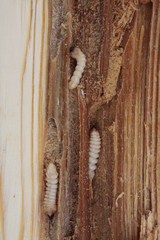 House LonghornHylotrupes bajulusCan damage your home
 Asian Longhorned BeetleAnoplophora glabripennisDamages trees, gardens or crops
 Red Milkweed BeetleTetraopes tetrophthalmus
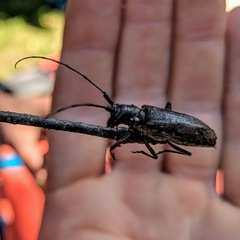 White-spotted SawyerMonochamus scutellatusCan damage your home
 Red Pine Longhorn BeetleStictoleptura rubra
 Spotted Longhorn BeetleRutpela maculataDamages trees, gardens or crops
Sources
- Wikipedia: https://en.wikipedia.org/wiki/Megacyllene_robiniae
Look it up elsewhere: GBIF · iNaturalist · BugGuide · ITIS · Wikipedia
Text written 2026-10-22 from the sources above and checked sentence by sentence against them. Data fetched 2026-10-22.