 Bug FAQ
Rabbit Hutch Spider
Steatoda bipunctata · Order: Araneae · Family: Theridiidae
Also called: The Rabbit Hutch Spider, Common False Widow, False widow
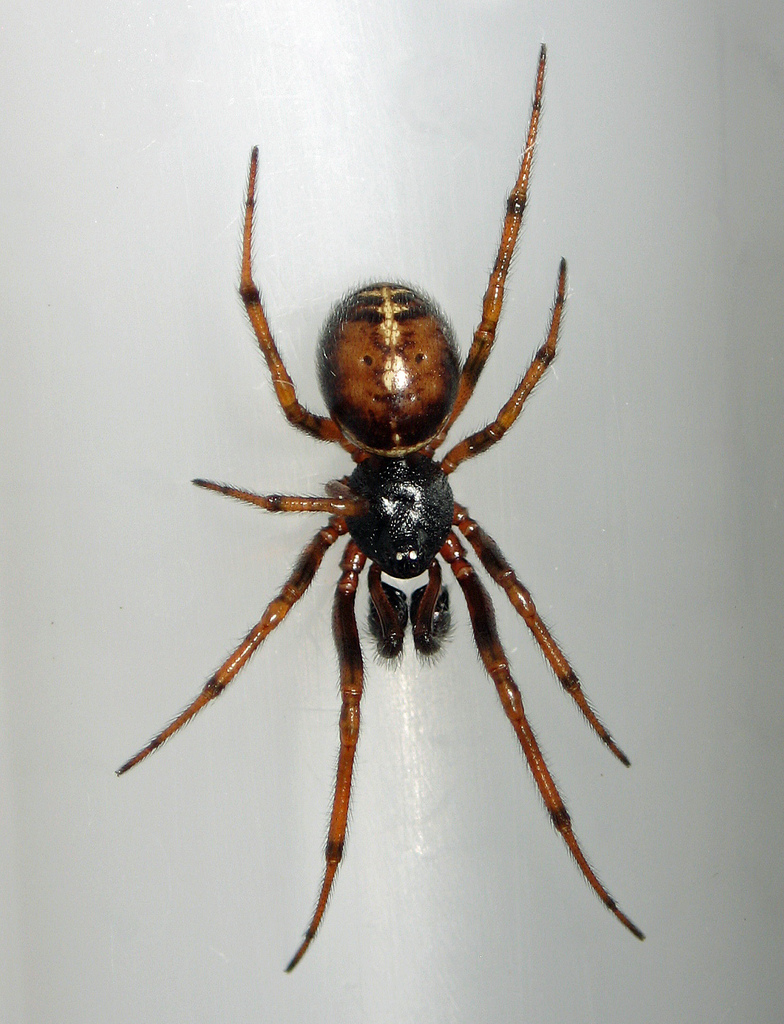
The rabbit hutch spider is a small brownish spider about 7 mm long, often found near basements, sheds, or rabbit hutches. It has a bulbous abdomen with pale lines and two dark dimples on the back, giving it its name “bipunctata.”
Source: Wikipedia
How to recognize it
Both sexes have a rounded brown abdomen with a broken pale line down the middle and another pale line near the front. Two dark dimples on the dorsal side of the abdomen give the species its “two-spotted” name.
Source: Wikipedia
Size
Adults rarely grow longer than 7 mm in body length.
Source: Wikipedia
Does it bite or sting?
No confirmed cases of envenomation exist, and the tiny fangs are unlikely to pierce human skin.
Source: Wikipedia
Where it lives
They are often found near human structures such as basements, sheds, and rabbit hutches.
Source: Wikipedia
Where it comes from
The species has a holarctic distribution and is common in both North America and Europe.
Source: Wikipedia
Lookalikes
Its shape resembles that of black widow spiders, leading to occasional misidentification, but it is a “false widow” with a much milder bite.
Source: Wikipedia
Where it is found in the US
Recorded in 9 of 51 states and DC. Most records: Maine, Washington, Massachusetts, Maryland, New Hampshire, Pennsylvania, Texas, Utah.
Darker = more records. Counts are museum and citizen-science records, not population size.
Source: GBIF
Status: introduced in Canada. Source: iNaturalist
Months it is reported in the US
Source: GBIF
More photos
Questions people ask
Where might I find them in my house?
They like dark, sheltered spots such as basements, sheds, or rabbit hutches.
Source: Wikipedia
Same family (Theridiidae)

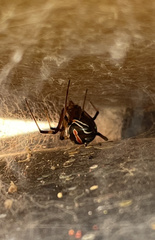

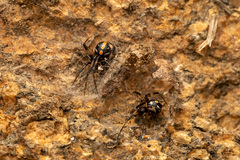
Sources
- Wikipedia: https://en.wikipedia.org/wiki/Steatoda_bipunctata
Look it up elsewhere: GBIF · iNaturalist · BugGuide · ITIS · Wikipedia
Text written 2026-10-22 from the sources above and checked sentence by sentence against them. Data fetched 2026-10-22.