 Bug FAQ
Triangulate Combfoot
Steatoda triangulosa · Order: Araneae · Family: Theridiidae
Also called: Triangulate Comb-foot, Triangulate Comb-foot Spider, triangulate Steatoda, triangulate bud spider
Source: Wikipedia, lsuagcenter.com

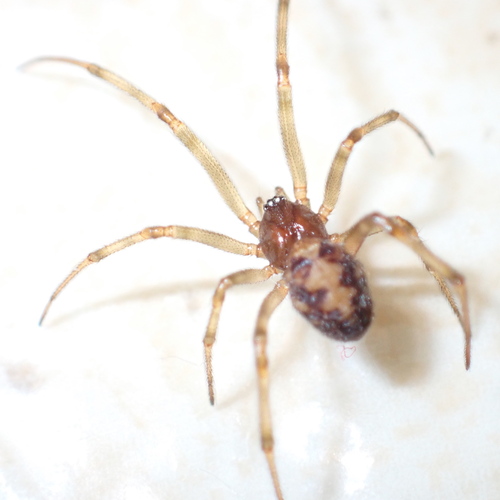
The triangulate cobweb spider is a small, cream-colored spider with a distinctive triangular pattern on its abdomen. It lives mainly inside homes, building webs in dark corners, and helps control other indoor insects. Bites are extremely rare; one case of envenomation has been noted, and any bite is considered mild and tolerable.
Source: Wikipedia, lsuagcenter.com
How to recognize it
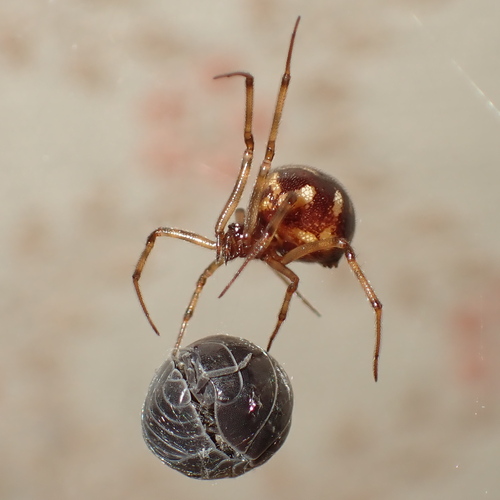
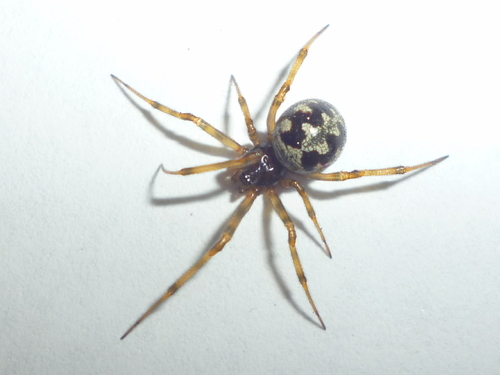
Females have a round, creamy abdomen marked with a pair of broad, purply-brown zig-zag bands that form a triangle shape on the back.
Source: Wikipedia, lsuagcenter.com
Size
Adult females measure about 3 to 6 mm (1/8 to 1/4 in) in body length. Males are smaller, about 2 to 4 mm (1/16 to 1/8 in).
Source: Wikipedia, lsuagcenter.com
Is it a pest in the house?
These spiders are not aggressive toward humans and often occur in large numbers inside homes, where they can provide some pest control.
Source: Wikipedia, lsuagcenter.com
Does it bite or sting?
There is a single recorded human envenomation; otherwise bites are extremely uncommon and considered mild.
Source: Wikipedia, lsuagcenter.com
How to get rid of it
Removing webs by vacuuming or sweeping is safe and effective for short-term control, while eliminating food sources is the only permanent solution.
Source: lsuagcenter.com
Where it lives
They spin three-dimensional cobwebs in dark, sheltered spots, usually close to surfaces inside buildings.
Source: Wikipedia
What it eats
They prey on a variety of arthropods such as ants, other spiders (including brown recluse), pillbugs, ticks, moths, flies and mosquitoes.
Source: Wikipedia, lsuagcenter.com
Life cycle
The egg sac is about the size of the spider and contains roughly 30 eggs.
Source: Wikipedia
Where it comes from
The species is originally from Eurasia but is now found worldwide, including in homes across North America.
Source: Wikipedia
Lookalikes
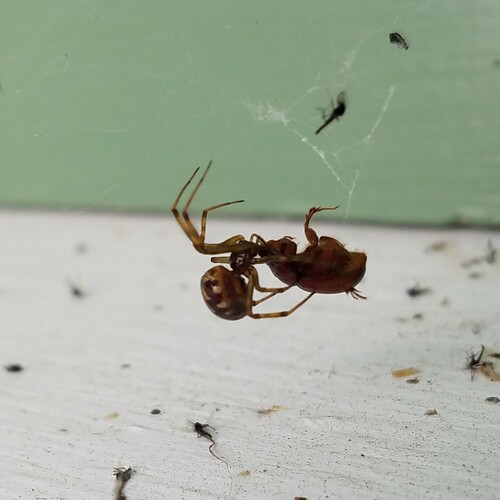
Males look similar to females but are smaller and have a narrower, oval abdomen; webs are typical cobwebs covering a broad area.
Source: lsuagcenter.com
Where it is found in the US
Recorded in 50 of 51 states and DC. Most records: Texas, Ohio, Pennsylvania, New York, Virginia, Illinois, California, Colorado.
Darker = more records. Counts are museum and citizen-science records, not population size.
Source: GBIF
Status: introduced in North America; introduced in United States; introduced in Canada. Source: iNaturalist
Months it is reported in the US
Source: GBIF
More photos
Questions people ask
Do they bite?
Bites are extremely rare; one mild envenomation case has been reported, and any bite is generally tolerable.
Source: Wikipedia, lsuagcenter.com
How can I get rid of them?
Vacuum or sweep away their webs, and reduce indoor insect prey to keep their numbers low.
Source: lsuagcenter.com
Same family (Theridiidae)


Sources
- Wikipedia: https://en.wikipedia.org/wiki/Triangulate_cobweb_spider
- lsuagcenter.com: https://www.lsuagcenter.com/articles/page1629822757888
Look it up elsewhere: GBIF · iNaturalist · BugGuide · ITIS · Wikipedia
Text written 2026-10-23 from the sources above and checked sentence by sentence against them. Data fetched 2026-10-23.