 Bug FAQ
Pine Ladybird
Exochomus quadripustulatus · Order: Coleoptera · Family: Coccinellidae
Also called: Ladybird beetle, Pine Lady Beetle

It lives on conifers and deciduous trees from April to October across most of Europe, the eastern Palearctic, and the Near East, feeding on aphids and scale insects such as the pine woolly aphid.
Source: Wikipedia
How to recognize it
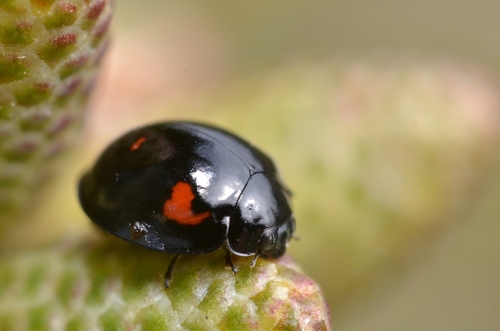
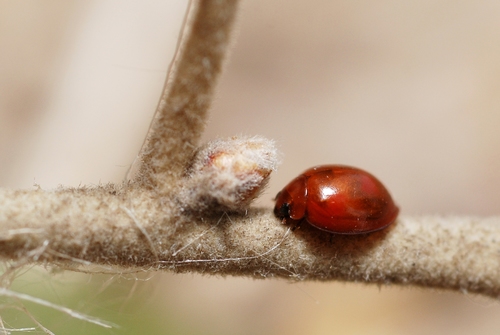
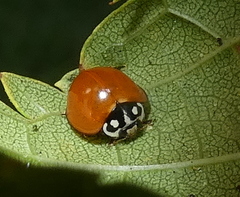
The beetle is almost circular, convex, shiny, and has a flange around the base of its wing covers.
Source: Wikipedia
Size
Adults measure about 4 to 6 mm in length.
Source: Wikipedia
Where it lives
You can find it on coniferous and deciduous trees from April through October.
Source: Wikipedia
What it eats
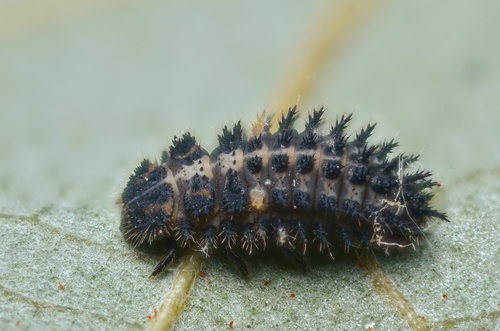
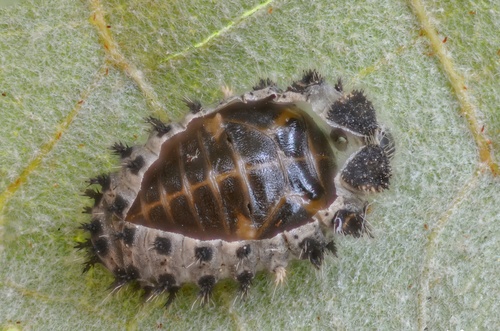
Both larvae and adults hunt aphids and scale insects, especially the pine woolly aphid (Diaspidiotus perniciosus).
Source: Wikipedia
Life cycle
Adult pine ladybirds overwinter and become active again in spring.
Source: Wikipedia
When you see it
They are most commonly seen from April to October.
Source: Wikipedia
Where it comes from
It occurs throughout most of Europe, the eastern Palearctic region, and the Near East.
Source: Wikipedia
Where it is found in the US
Recorded in 7 of 51 states and DC. Most records: California, Washington, Oregon, Massachusetts, Utah, Idaho, Georgia.
Darker = more records. Counts are museum and citizen-science records, not population size.
Source: GBIF
Status: introduced in United States; introduced in Canada. Source: iNaturalist
Months it is reported in the US
Source: GBIF
More photos
Same family (Coccinellidae)

Sources
- Wikipedia: https://en.wikipedia.org/wiki/Exochomus_quadripustulatus
Look it up elsewhere: GBIF · iNaturalist · BugGuide · Wikipedia
Text written 2026-10-22 from the sources above and checked sentence by sentence against them. Data fetched 2026-10-22.