 Bug FAQ
Phasia hemiptera
Phasia hemiptera · Order: Diptera · Family: Tachinidae

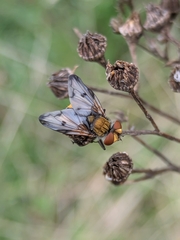
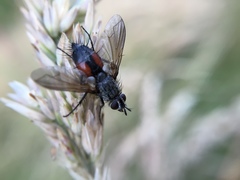
Phasia hemiptera is a small tachinid fly about 10 to 11 mm long. Males have dark brown thoraxes, brightly patterned wings that may show an iridescent blue-black band, and reddish-yellow hind legs; females are slimmer, have clearer wings without markings and narrower bodies.
Source: Wikipedia
How to recognize it
The thorax is dark brown, the central abdomen is dark brown or black with orange-brown hairy sides. Males have broad, curved wings with colorful patterns that can include an iridescent blue-black band; females have narrower, more transparent wings without markings. The hind legs are generally reddish-yellow.
Source: Wikipedia
Size
The fly reaches a body length of roughly 10 to 11 mm (0.39 to 0.43 in).
Source: Wikipedia
Where it lives
Adults are active from April through September and visit many flowering plants for pollen, especially those in the Apiaceae and Asteraceae families.
Source: Wikipedia
What it eats
Adults feed on pollen from a wide range of flowering plants, favoring umbellifers and asters.
Source: Wikipedia
Life cycle
The species has two generations per year (bivoltine). Males can live up to 31 days, while females live up to 21 days.
Source: Wikipedia
When you see it
Adults are visible from April to September.
Source: Wikipedia
Where it comes from
It occurs across much of Europe and parts of Asia, including the British Isles, Scandinavia, Central and Southern Europe, the Balkans, Turkey, Iran, Russia, China, Japan, and both Koreas.
Source: Wikipedia
Lookalikes
Phasia hemiptera belongs to the tachinid fly family Tachinidae.
Source: Wikipedia
More photos


Questions people ask
How can I tell male and female Phasia hemiptera apart?
Males have broader, patterned wings that may show a blue-black band and a darker abdomen, while females have narrower, clearer wings without markings and a slimmer body.
Source: Wikipedia
What do they eat?
They feed on pollen from many flowering plants, especially umbellifers and asters.
Source: Wikipedia
Where is Phasia hemiptera found?
It is found throughout Europe and parts of Asia, including the British Isles, Scandinavia, Central and Southern Europe, the Balkans, Turkey, Iran, Russia, China, Japan, and both Koreas.
Source: Wikipedia
Same family (Tachinidae)




Sources
- Wikipedia: https://en.wikipedia.org/wiki/Phasia_hemiptera
Look it up elsewhere: GBIF · iNaturalist · BugGuide · Wikipedia
Text written 2026-10-23 from the sources above and checked sentence by sentence against them. Data fetched 2026-10-22.