 Bug FAQ
Pearly Green Lacewing
Chrysopa perla · Order: Neuroptera · Family: Chrysopidae

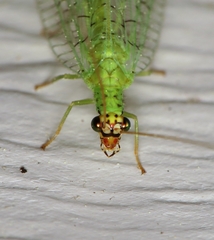
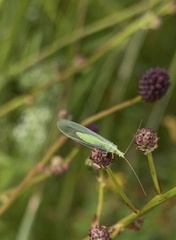
The pearly green lacewing is a small green insect about 10 to 12 mm long with a 25 to 30 mm wingspan; its wings are blue-green with dark veins and it turns pale yellow in winter. Adults are active from May through August and prey on aphids, while the larvae also eat aphids, scale insects and some caterpillars.
Source: Wikipedia
Size
Adults measure 10 to 12 mm in length with a wingspan of 25 to 30 mm.
Source: Wikipedia
What it eats
Adults feed mainly on aphids and occasionally sip flower nectar. Larvae are predators of aphids, scale insects and certain caterpillars such as cabbage white and silver Y.
Source: Wikipedia
Life cycle
Adults hibernate during the winter months.
Source: Wikipedia
When you see it
Adults can be seen from May through August.
Source: Wikipedia
Where it comes from
The species occurs throughout most of Europe and in temperate parts of Asia.
Source: Wikipedia
Lookalikes
It resembles Chrysopa dorsalis but can be told apart by an oval pale spot between the eyes that is roundish in C. perla.
Source: Wikipedia
Where it is found in the US
Recorded in 1 of 51 states and DC. Most records: Georgia.
Darker = more records. Counts are museum and citizen-science records, not population size.
Source: GBIF
Questions people ask
What do adult pearly green lacewings eat?
They mainly hunt aphids and may also drink flower nectar.
Source: Wikipedia
Where can I find pearly green lacewings?
Look for them in cool, shady habitats like deciduous woods, wet forests, hedge rows and scrubby grassland.
Source: Wikipedia
Same family (Chrysopidae)



Sources
- Wikipedia: https://en.wikipedia.org/wiki/Chrysopa_perla
Look it up elsewhere: GBIF · iNaturalist · BugGuide · Wikipedia
Text written 2026-10-22 from the sources above and checked sentence by sentence against them. Data fetched 2026-10-22.