 Bug FAQ
Common green lacewing
Chrysoperla carnea · Order: Neuroptera · Family: Chrysopidae
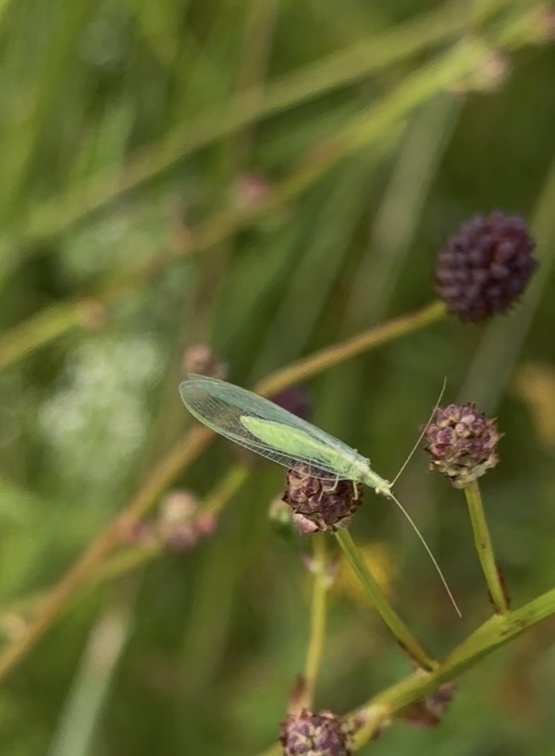
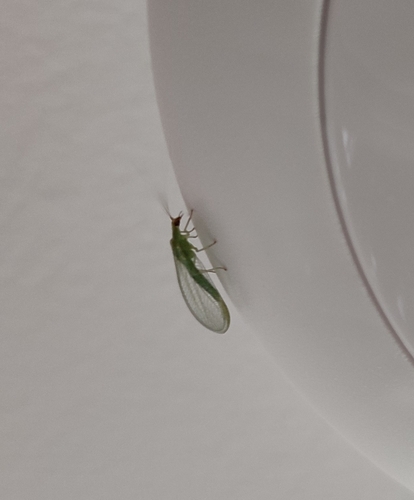
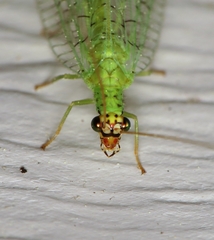
Adult green lacewings are about 11-12 mm long, pale green with long threadlike antennae and golden eyes. They fly weakly with a fluttery motion and are attracted to lights at night. The species is widespread in the Northern Hemisphere, especially in Europe and hedgerows or woodland.
Source: Wikipedia
How to recognize it
They are weak fliers with a fluttery flight style.
Source: Wikipedia
Size
Adults measure about 11-12 mm in body length.
Source: Wikipedia
Where it lives
They are commonly found in hedgerows and woodland. They occur naturally across many growing regions of the Northern Hemisphere.
Source: Wikipedia
What it eats
Larvae have been recorded eating at least seventy different prey species from five insect orders.
Source: Wikipedia
Life cycle
Adults overwinter in leaf litter and emerge in spring when it warms up. The life cycle can be under four weeks in summer and several generations may occur each year.
Source: Wikipedia
When you see it
They are often seen in the evenings and at night, attracted to lights. Adults emerge in spring as the weather warms.
Source: Wikipedia
Where it comes from
Chrysoperla carnea is a widespread European species.
Source: Wikipedia
Lookalikes
What is called Chrysoperla carnea is actually a complex of many cryptic sibling subspecies. These subspecies look identical but differ in the vibrational songs they use to communicate.
Source: Wikipedia
Where it is found in the US
Recorded in 11 of 51 states and DC. Most records: Pennsylvania, South Carolina, California, Ohio, Kentucky, Alaska, Texas, Florida.
Darker = more records. Counts are museum and citizen-science records, not population size.
Source: GBIF
Months it is reported in the US
Source: GBIF
More photos
Questions people ask
What do green lacewing larvae eat?
The larvae are active predators that feed on aphids and a wide range of other small insects.
Source: Wikipedia
When do green lacewings appear?
Adults emerge in spring as temperatures rise and are often seen at night near lights.
Source: Wikipedia
Where are green lacewings found?
They live in hedgerows and woodland across much of the Northern Hemisphere, especially in Europe.
Source: Wikipedia
Same family (Chrysopidae)


Sources
- Wikipedia: https://en.wikipedia.org/wiki/Chrysoperla_carnea
Look it up elsewhere: GBIF · iNaturalist · BugGuide · ITIS · Wikipedia
Text written 2026-10-22 from the sources above and checked sentence by sentence against them. Data fetched 2026-10-22.