 Bug FAQ
Parexochomus nigripennis
Parexochomus nigripennis · Order: Coleoptera · Family: Coccinellidae

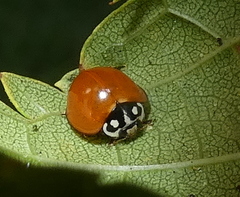
Adults are tiny, measuring about 3.5 to 4.5 mm in length. They have a yellowish head and pronotum, black shiny wing covers, and a yellow-brown underside. They hunt aphids and scale insects, helping control these plant pests.
Source: Wikipedia
How to recognize it
The head and pronotum are yellowish, the elytra are black and glossy, and the ventral side is yellow-brown.
Source: Wikipedia
What it eats
It preys on aphids and scale insects.
Source: Wikipedia
Life cycle
Its life cycle includes feeding on aphids and scale insects.
Source: Wikipedia
Where it comes from
It occurs in India, Pakistan, Afghanistan, the Afrotropical and Mediterranean regions, and the Middle East.
Source: Wikipedia
Questions people ask
Where is this species found?
It is found in India, Pakistan, Afghanistan, the Afrotropical and Mediterranean regions, and the Middle East.
Source: Wikipedia
Same family (Coccinellidae)


Sources
- Wikipedia: https://en.wikipedia.org/wiki/Parexochomus_nigripennis
Look it up elsewhere: GBIF · iNaturalist · BugGuide · Wikipedia
Text written 2026-10-23 from the sources above and checked sentence by sentence against them. Data fetched 2026-10-23.