 Bug FAQ
Pachyta quadrimaculata
Pachyta quadrimaculata · Order: Coleoptera · Family: Cerambycidae


Adult Pachyta quadrimaculata are 11 to 22 mm long, black-bodied with straw-yellow wing covers marked by four large black spots (two per elytron). They live in coniferous forests across much of Europe and into Siberia, flying from mid-June to early August.
Source: Wikipedia
How to recognize it
The beetle has a black body and straw-yellow elytra with four prominent black spots, two on each wing cover.
Source: Wikipedia
Size
Adults range from about 11 to 22 mm in length.
Source: Wikipedia
Where it lives
It is found in coniferous forests and on forest paths throughout Europe.
Source: Wikipedia
What it eats
Adults visit flowers, especially flowering shrubs and Apiaceae, for food. Larvae develop in dead roots of Scots pine and Norway spruce, feeding on the wood of these conifers.
Source: Wikipedia
Life cycle
The adult stage may last up to three years.
Source: Wikipedia
When you see it
Adults are on the wing from mid-June until early August.
Source: Wikipedia
Where it comes from
The species occurs in many European countries including Austria, France, Germany, Italy, Spain, and extends eastward to Siberia, but it is absent from the British Isles and the Netherlands.
Source: Wikipedia
More photos


Same family (Cerambycidae)
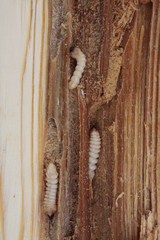 House LonghornHylotrupes bajulusCan damage your home
 Asian Longhorned BeetleAnoplophora glabripennisDamages trees, gardens or crops
 Red Milkweed BeetleTetraopes tetrophthalmus
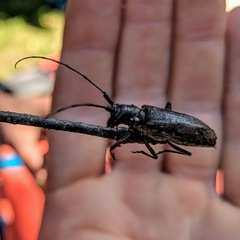 White-spotted SawyerMonochamus scutellatusCan damage your home
 Red Pine Longhorn BeetleStictoleptura rubra
 Spotted Longhorn BeetleRutpela maculataDamages trees, gardens or crops
Sources
- Wikipedia: https://en.wikipedia.org/wiki/Pachyta_quadrimaculata
Look it up elsewhere: GBIF · iNaturalist · BugGuide · Wikipedia
Text written 2026-10-23 from the sources above and checked sentence by sentence against them. Data fetched 2026-10-22.