 Bug FAQ
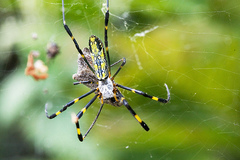
Ornamental Tree Trunk Spider
Herennia multipuncta · Order: Araneae · Family: Araneidae
Also called: Spotted Coin Spider

These spiders live on tree trunks and building walls, where they spin a small web close to the surface, and they are considered invasive and synanthropic.
Source: Wikipedia
Size
Males are 5 to 7 mm long and reddish-brown with dark legs; females are larger at 10 to 14 mm. Females are much larger than males, showing strong sexual dimorphism.
Source: Wikipedia
Is it a pest in the house?
The spider is often found in association with humans and has spread to other countries as an invasive, synanthropic species.
Source: Wikipedia
Where it lives
They are found on the trunks of trees and on building walls, where they build a small surface-close web. The species is invasive and lives closely with humans (synanthropic).
Source: Wikipedia
What it eats
They rest head-down on their web with legs flexed.
Source: Wikipedia
Life cycle
Females are much larger than males, a clear case of sexual dimorphism. During many matings, the terminal joint of the male’s palps stays attached inside the female, especially when she is aggressive.
Source: Wikipedia
Where it comes from
Herennia multipuncta is native to Asia.
Source: Wikipedia
More photos


Questions people ask
Where is this spider usually found?
It lives on tree trunks and building walls, building a small web close to the surface, and it is considered invasive and synanthropic, often found near humans.
Source: Wikipedia
How big are male and female spiders?
Males are about 5 to 7 mm long, while females are larger at 10 to 14 mm.
Source: Wikipedia
Same family (Araneidae)



Sources
- Wikipedia: https://en.wikipedia.org/wiki/Herennia_multipuncta
Look it up elsewhere: GBIF · iNaturalist · BugGuide · ITIS · Wikipedia
Text written 2026-10-23 from the sources above and checked sentence by sentence against them. Data fetched 2026-10-22.