 Bug FAQ
Oregon Stag Beetle
Platycerus oregonensis · Order: Coleoptera · Family: Lucanidae
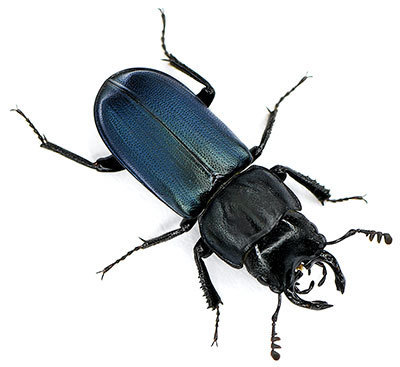
Male Oregon stag beetles are 11.2 to 15.4 mm long and females 9.6 to 13.9 mm. They have a black head and pronotum, blue elytra (or black-green in a coastal Oregon population), and lack denticles on the mandibles. Larvae live in decaying wood of maple, holly, madrone, oak, gum and alder, feeding on the soft wood without harming live plants.
Source: Wikipedia
How to recognize it
The head and pronotum are black, while the wing covers are blue except in a coastal Oregon group that is black-green.
Source: Wikipedia
Size
Males measure 11.2 to 15.4 mm (0.44 to 0.61 in) and females 9.6 to 13.9 mm (0.38 to 0.55 in).
Source: Wikipedia
Where it lives
It occurs across western North America from British Columbia to California.
Source: Wikipedia
What it eats
Larvae feed on soft, decaying wood and are not known to damage live plants.
Source: Wikipedia
Where it comes from
The Oregon stag beetle is native to western North America, ranging from British Columbia south to California.
Source: Wikipedia
Where it is found in the US
Recorded in 6 of 51 states and DC. Most records: California, Washington, Oregon, Alaska, Kansas, Arizona.
Darker = more records. Counts are museum and citizen-science records, not population size.
Source: GBIF
Status: native in North America; native in Canada. Source: iNaturalist
Months it is reported in the US
Source: GBIF
More photos

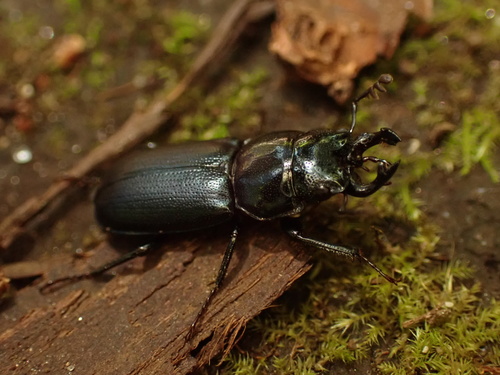
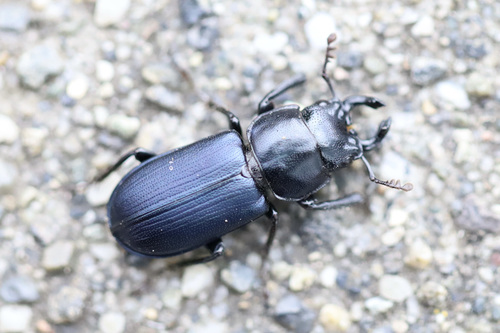
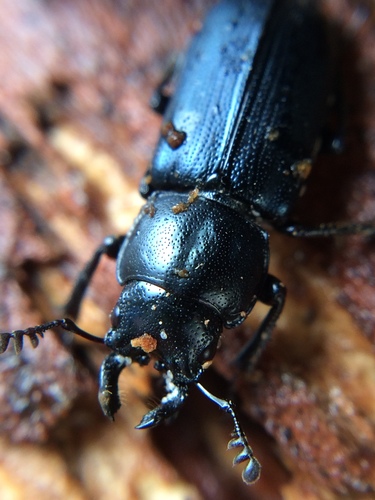
Questions people ask
How can I identify an Oregon stag beetle?
Look for a black head and pronotum, blue (or black-green in coastal Oregon) wing covers, long mandibles without denticles, and black markings on the mandible edges.
Source: Wikipedia
What does the larva eat?
The larvae eat soft, decaying wood from trees such as maple, holly, madrone, oak, gum and alder.
Source: Wikipedia
Where is this beetle found?
It lives across western North America, from British Columbia down to California.
Source: Wikipedia
How big do they get?
Males are 11.2 to 15.4 mm long and females are 9.6 to 13.9 mm long.
Source: Wikipedia
Same family (Lucanidae)


Sources
- Wikipedia: https://en.wikipedia.org/wiki/Platycerus_oregonensis
Look it up elsewhere: GBIF · iNaturalist · BugGuide · ITIS · Wikipedia
Text written 2026-10-27 from the sources above and checked sentence by sentence against them. Data fetched 2026-10-27.