 Bug FAQ
European Stag Beetle
Lucanus cervus · Order: Coleoptera · Family: Lucanidae
Also called: Stag Beetle
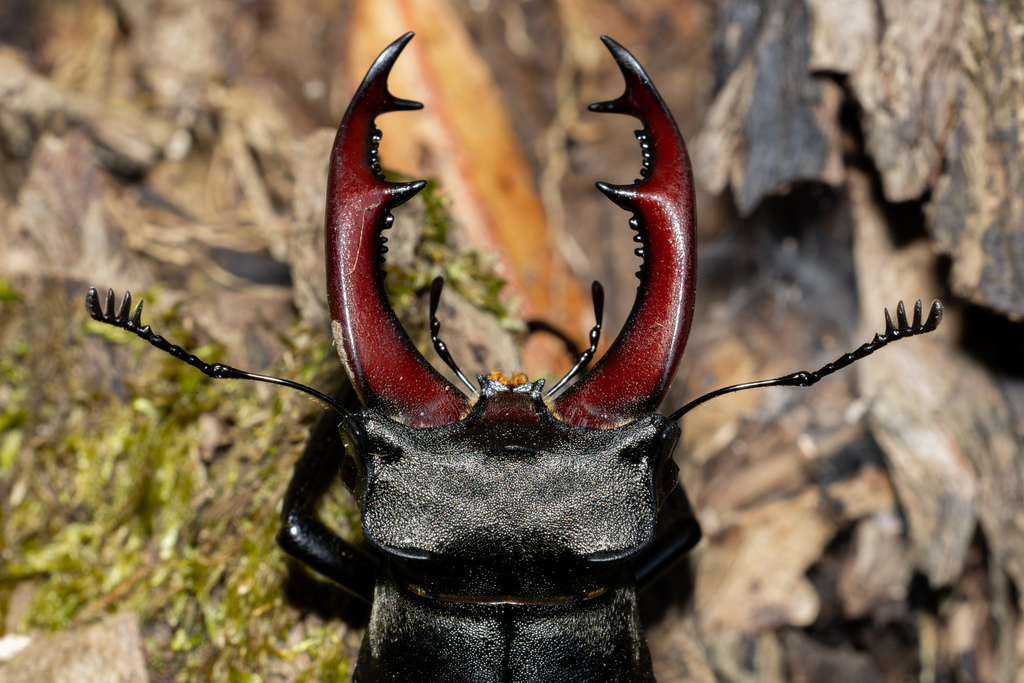
Adults appear from late May to early August, are most active in the evenings, and feed on nectar, fruit juices and tree sap. Larvae live in rotting wood and take several years to develop before pupating in the soil for about three months.
Source: Wikipedia
How to recognize it
They are usually black with reddish wing covers, and males have large red mandibles.
Source: Wikipedia
Size
Males grow up to 7.5 cm (3 in) long, while females are 3 to 5 cm (1.2 to 2 in). It is the biggest beetle species found in Europe.
Source: Wikipedia
Does it bite or sting?
Females can give a painful bite. Male mandibles look threatening but are too weak to cause harm.
Source: Wikipedia
Where it lives
They are linked to many tree species such as oak, lime, beech, willow, black poplar, ash, horse chestnut, wild cherry and common walnut. Larvae are often found near dead wood of non-native red oak (Quercus rubra).
Source: Wikipedia
What it eats
Larvae, which are blind and C-shaped, eat decaying wood in stumps, old trees, fence posts, compost and leaf mould. Adults sip liquids from nectar, fallen fruit and tree sap.
Source: Wikipedia
Life cycle
Larvae pass through several growth stages over several years before becoming pupae. Pupae stay in the soil for about three months and emerge in summer to fly and mate.
Source: Wikipedia
When you see it
Adults are seen from late May to early August, especially in the evenings.
Source: Wikipedia
Where it comes from
They occur widely across Europe but are absent from Ireland, and are also present in the European part of Turkey and northern-central Italy.
Source: Wikipedia
Lookalikes
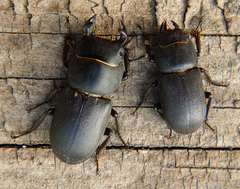
Female European stag beetles are often mistaken for the lesser stag beetle, which is smaller, completely black and has a larger, squarer head.
Source: Wikipedia
Where it is found in the US
Recorded in 1 of 51 states and DC. Most records: Kansas.
Darker = more records. Counts are museum and citizen-science records, not population size.
Source: GBIF
Questions people ask
Do stag beetles bite?
Yes, females can bite painfully, while males cannot cause injury with their mandibles.
Source: Wikipedia
When can I see adult stag beetles?
Adults are active from late May through early August, especially in the evenings.
Source: Wikipedia
What do stag beetle larvae eat?
The larvae feed on rotting wood found in tree stumps, old trees, fence posts, compost heaps and leaf mould.
Source: Wikipedia
How big do European stag beetles get?
Males can reach up to 7.5 cm (3 in) in length, while females are 3 to 5 cm (1.2 to 2 in).
Source: Wikipedia
Same family (Lucanidae)


Sources
- Wikipedia: https://en.wikipedia.org/wiki/Lucanus_cervus
Look it up elsewhere: GBIF · iNaturalist · BugGuide · Wikipedia
Text written 2026-10-22 from the sources above and checked sentence by sentence against them. Data fetched 2026-10-22.