 Bug FAQ
Orange-spotted Scaphidium
Scaphidium quadrimaculatum · Order: Coleoptera · Family: Staphylinidae
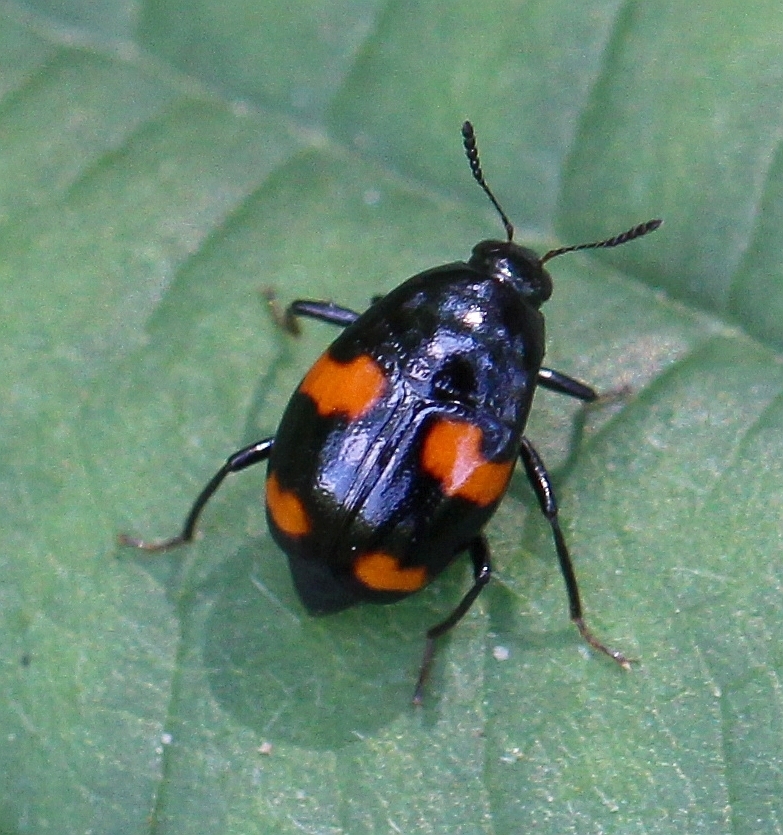
Adults appear from April to August and feed on fungi, especially bracket fungi. It is found across most of Europe, North Africa and the Near East.
Source: Wikipedia
How to recognize it
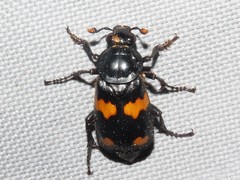
It is a glossy black beetle with four irregular red spots on the elytra; the wing covers are heavily punctured and the tibiae have fine striations.
Source: Wikipedia
Size
Adults measure about 5 to 6 mm (0.20 to 0.24 in) in length.
Source: Wikipedia
Where it lives
You will mostly find them from April through August on various fungi, especially bracket fungi.
Source: Wikipedia
What it eats
Adults feed on a range of fungi, with a preference for bracket fungi.
Source: Wikipedia
Life cycle
Adults are present from April to August, feeding on fungi during this period.
Source: Wikipedia
When you see it
The beetles are active from April through August.
Source: Wikipedia
Where it comes from
They occur in most of Europe, as well as in North Africa and the Near East.
Source: Wikipedia
Questions people ask
When can I expect to see orange-spotted Scaphidium?
Adults are typically seen from April to August.
Source: Wikipedia
What do these beetles look like?
They are shiny black, about 5 to 6 mm long, with four irregular red spots on the elytra and punctured wing covers.
Source: Wikipedia
Where are orange-spotted Scaphidium found?
They occur across most of Europe, North Africa and the Near East.
Source: Wikipedia
Same family (Staphylinidae)


Sources
- Wikipedia: https://en.wikipedia.org/wiki/Scaphidium_quadrimaculatum
Look it up elsewhere: GBIF · iNaturalist · BugGuide · Wikipedia
Text written 2026-10-23 from the sources above and checked sentence by sentence against them. Data fetched 2026-10-22.