 Bug FAQ
Orange Ladybird
Halyzia sedecimguttata · Order: Coleoptera · Family: Coccinellidae
Also called: 16-spot Ladybird [Halyzia sedecimguttata], Orange Lady Beetle, Orange Ladybird Beetle
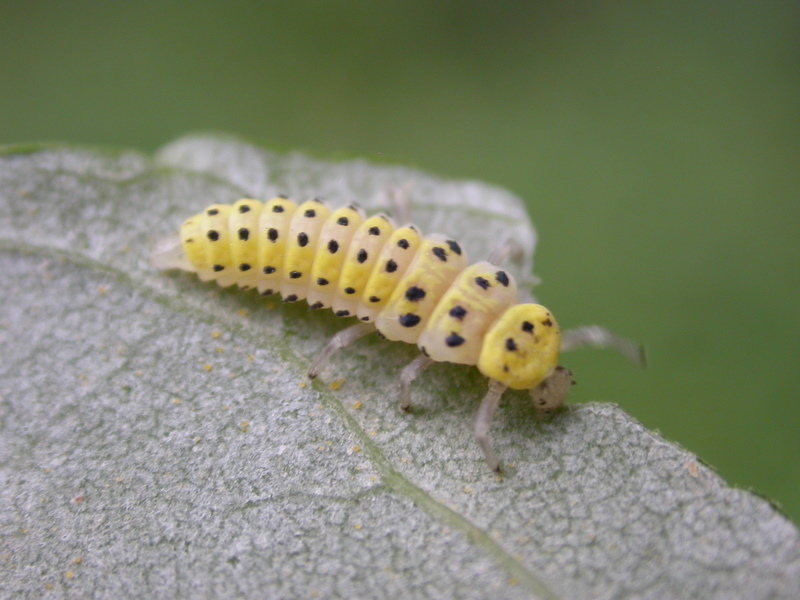
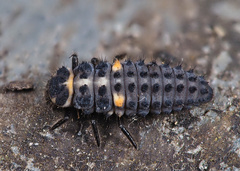
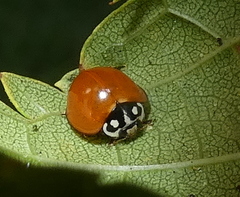
The orange ladybird is a small, round beetle about 5 to 6 mm long that lives in woodlands and park edges across much of Europe and Asia. Adults appear from spring through autumn and spend winter under bark or in leaf litter; both larvae and adults eat mildew and occasional aphids on a variety of trees.
Source: Wikipedia
How to recognize it
It has an oval, rather round body shape.
Source: Wikipedia
Size
It measures about 5 to 6 mm in length.
Source: Wikipedia
Where it lives
It is common in dry deciduous woodlands, parkland, forest edges and hedges.
Source: Wikipedia
What it eats
Both larvae and adults feed on leaf mildew and sometimes on small aphids. They especially eat mildew on trees such as oak, lime, elm, sycamore, hazel, ash, alders and also on conifers, and may pick up aphids on those trees.
Source: Wikipedia
Life cycle
Adults are seen from April to October and overwinter under bark or in leaf litter.
Source: Wikipedia
When you see it
Adults are visible from April through October.
Source: Wikipedia
Where it comes from
It occurs throughout Europe, parts of Russia, the Caucasus, Siberia, the Far East, Kazakhstan, Asia Minor, Mongolia, northern China and Japan.
Source: Wikipedia
Lookalikes
It looks similar to Calvia decemguttata and Vibidia duodecimguttata.
Source: Wikipedia
Where it is found in the US
Recorded in 1 of 51 states and DC. Most records: Kansas.
Darker = more records. Counts are museum and citizen-science records, not population size.
Source: GBIF
More photos


Questions people ask
Where can I find orange ladybirds?
Look for them in dry deciduous woodlands, park edges, hedges and forest margins from spring to autumn.
Source: Wikipedia
Same family (Coccinellidae)

Sources
- Wikipedia: https://en.wikipedia.org/wiki/Halyzia_sedecimguttata
Look it up elsewhere: GBIF · iNaturalist · BugGuide · Wikipedia
Text written 2026-10-22 from the sources above and checked sentence by sentence against them. Data fetched 2026-10-22.