 Bug FAQ
Nicrophorus nepalensis
Nicrophorus nepalensis · Order: Coleoptera · Family: Staphylinidae

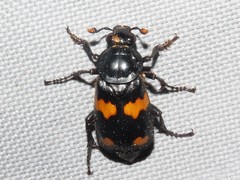
Adult Nicrophorus nepalensis are 3.6 to 7.0 mm wide at the pronotum, with no size difference between sexes. They have a shiny black body, four orange scalloped elytral marks with black dots, and antennae that end in a three-segment orange club. These beetles live in cool, high-elevation tropical areas but can also be found lower down where it is warmer, and they range across mountainous eastern Asia to the Malay Archipelago. N. nepalensis acts as a decomposer and shows biparental care of its offspring, which reduces as the young grow older.
Source: Wikipedia
How to recognize it
The beetle’s body is glossy black with four separate orange, scalloped markings on the elytra, each bearing black dots. Its antennae have a black base and end in a club of three orange segments.
Source: Wikipedia
Size
Adults measure 3.6 to 7.0 mm across the pronotum, and males and females are the same size.
Source: Wikipedia
Where it lives
The species moves up and down elevation gradients to stay within its preferred temperature range. In tropical regions it is usually found at high, cool elevations but can also occur at lower, warmer sites.
Source: Wikipedia
What it eats
N. nepalensis helps decompose dead material, playing a key role in ecosystem energy flow.
Source: Wikipedia
Life cycle
Both parents care for the brood, a behavior that lessens as the offspring mature.
Source: Wikipedia
Where it comes from
It is native to mountainous parts of eastern Asia and the Malay Archipelago, from Pakistan (73° E) eastward to Papua New Guinea (149° E) and from Russia’s Ussuri region (51° N) down to Papua New Guinea (9° 48′ S).
Source: Wikipedia
More photos


Questions people ask
How can I recognize Nicrophorus nepalensis?
Look for a shiny black beetle about 4 to 7 mm wide with four orange scalloped spots on the wing covers and a three-segment orange club at the tip of the antennae.
Source: Wikipedia
Where might I find this beetle?
It lives in cool, high-elevation tropical mountains but can also be present at lower, warmer elevations across eastern Asia to the Malay Archipelago.
Source: Wikipedia
Same family (Staphylinidae)



Sources
- Wikipedia: https://en.wikipedia.org/wiki/Nicrophorus_nepalensis
Look it up elsewhere: GBIF · iNaturalist · BugGuide · ITIS · Wikipedia
Text written 2026-10-23 from the sources above and checked sentence by sentence against them. Data fetched 2026-10-23.